

|
Getting your Trinity Audio player ready… |
The finding in one line: Worldwide search interest in Korean skincare was about seven times higher in the last year than in the first year of our five-year window, yet the latest weeks are 21 percent below the same weeks of 2025 and well off a spring 2026 peak.
K-beauty has not stopped spreading; the pattern of where and what people search for, and what the press writes about, has changed.
We compared three signals that rarely get read together: the audience’s own searches, the volume and content of news and blog coverage, and the research literature. We also asked which countries each signal points to. The signals agree on growth. They disagree on geography, and that disagreement is the most useful result.
Coverage grew faster than the category around it
News and blog articles that mention K-beauty want from 184 in 2020 to 1,328 in 2025, a sevenfold increase. Articles about skincare in general want from 9,091 to 23,292 over the same years, about 2.6 times.
K-beauty is therefore gaining attention beyond the growth of its parent category. Quarterly counts reached 433 in the first quarter of 2026, against 60 in the first quarter of 2020.
The comparison with skincare matters because the archive of articles may itself have grown during these years; a rise far steeper than the surrounding category cannot be put down to the archive alone.

Search interest Increased sharply, then slipped from its peak
Weekly worldwide search interest in “korean skincare” averaged 9.6 on a 0 to 100 scale in the first 52 weeks of the window (from late October 2021) and 65.7 in the latest 52 weeks, a 6.8-fold gain.
The highest single week was 12 April 2026. Since then the series has fallen: the latest eight weeks average 47, against 60 for the same eight weeks a year earlier, a drop of 21 per cent. “K beauty” behaves differently. It averages 35 over the latest eight weeks against 28 a year earlier, up 26 per cent, while “snail mucin” has fallen from 28 to 19.
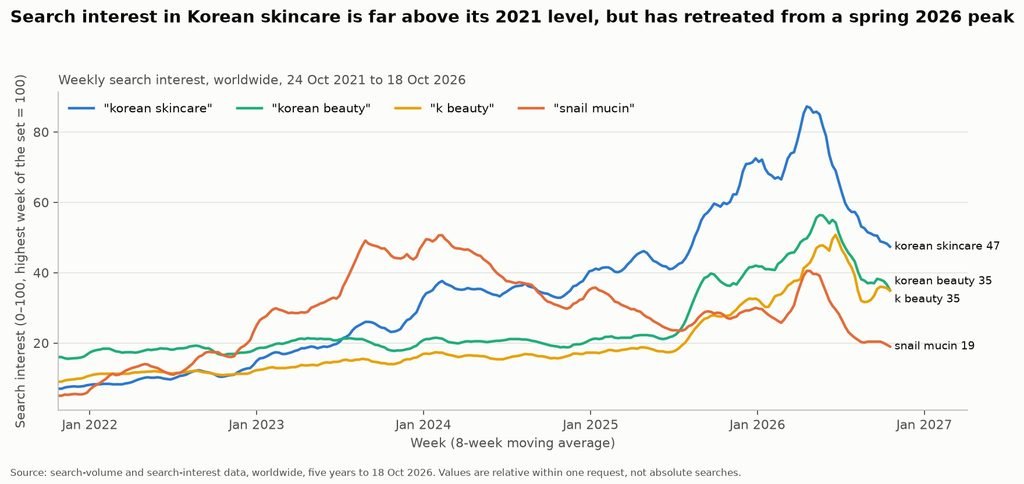
One reading is that broad curiosity (“korean skincare“) has peaked while the umbrella term (“k beauty“) is still being adopted by new audiences. This is a reading, not a proven cause. The data cannot say whether a one-off event lifted the spring 2026 peak.
How interest travels: a ladder from Southeast Asia outward
For 20 markets we measured the date on which search interest in “korean skincare” first reached half of its current level.
The order is clear. The Philippines (January 2022), Malaysia (February 2022) and Indonesia (April 2022) came first; these were already well established when our window opened, so their true start is earlier.
Singapore (March 2023) and India (May 2023) followed, then Canada and Sweden (July 2023), Australia (December 2023), and the United States, United Kingdom and Germany together in January 2024. France reached the mark in February 2024, South Africa in August 2024 and Vietnam in April 2025.
Brazil, Mexico, Japan and Thailand crossed it only in November and December 2025.

The timing is consistent with demand moving from the early Asian markets to English-speaking ones and then to late-adopting regions. It does not prove that one market caused another, and the late group may partly reflect people there searching in their own language, which an English query cannot see.
Which categories draw growing interest
We selected the 24 queries with at least 4,000 monthly US searches. Of the 23 where interest was high enough to measure, 22 rose over the last 12 months against the 12 before, with a median gain of 51 per cent.
The leaders are “glass skin” (+164 per cent) and the brand Medicube (+160 per cent), followed by “k beauty” (+83), “korean moisturizer” (+76), Torriden (+75) and Anua (+60). Sunscreen (+56) and toner (+51) sit near the median.
The names that defined the earlier wave are flat: Innisfree (+12), Laneige (+11) and “snail mucin” (-5).

Press attention points the same way. Articles mentioning PDRN, a skincare ingredient, want from 17 in 2022 to 395 in 2025. Mentions of the retailer Olive Young want from 40 to 359, and “Korean sunscreen” from 2 to 26.
| Query | US monthly searches | UK | India | 12-month change |
| medicube | 301,000 | 135,000 | 33,100 | +160% |
| laneige | 165,000 | 49,500 | 40,500 | +11% |
| korean skincare | 110,000 | 49,500 | 12,100 | +43% |
| beauty of joseon | 110,000 | 74,000 | 40,500 | +42% |
| snail mucin | 40,500 | 9,900 | 74,000 | -5% |
| korean sunscreen | 40,500 | 5,400 | 18,100 | +56% |
| glass skin | 14,800 | 6,600 | 9,900 | +164% |
| rice toner | 5,400 | 2,400 | 9,900 | +39% |
Table 1. Selected audience searches: monthly search-volume estimates (rounded) and change in worldwide interest. The full list of 24 is in the accompanying data file.
Where searches concentrate by country
Absolute volumes favour the United States, which leads on brand names such as Medicube (301,000 monthly searches, against 33,100 in India). India leans toward ingredients: “snail mucin” is searched about 74,000 times a month in India and 40,500 in the US, and “rice toner” 9,900 against 5,400.
These volumes are rounded estimates, and India’s higher figures may include other uses of the same words.
Relative intensity gives a different picture. Measured as the share of a country’s own searches, “korean skincare” is highest in the Netherlands (index 100), New Zealand (74), Australia (70), Singapore and Belgium (53), South Korea (51), Ireland and the United Kingdom (50) and Canada (46). The United States scores 32, India 7, Japan 6, Indonesia 4 and Brazil 3.

What the news is talking about: rising and falling themes
Searches show what audiences want; the news shows what the trade and the press choose to put in front of them.
We compared the themes in K-beauty coverage across two equal windows: the 12 months from 1 June 2025 to 31 May 2026, and the 12 months from 1 June 2024 to 31 May 2025.
We stopped at 31 May 2026 because news collection thins after that date and a partial month would look like a decline. Coverage itself grew between the windows, from 894 articles to 1,501 (+68 per cent), so a theme can lose share while still gaining stories.
An article may carry several labels, so the shares below do not add up to 100 per cent. Each figure is the share of K-beauty articles that carry the label, with the number of articles in brackets for the earlier and later window.
The themes, with our plain-language reading of each label:
⦁ Retail (category): stores, retailers, sales and shelf space.
⦁ Skin and nail care (product area): skincare products and routines.
⦁ Culture (category): the Korean Wave, tourism and entertainment tie-ins.
⦁ Marketing (category): campaigns, advertising, influencers and brand launches.
⦁ Sun care (product area): sunscreen and UV protection.
⦁ Make-up and cosmetics (product area): colour cosmetics and base make-up.
⦁ Clean beauty (product area): ingredient-light, sustainability-led positioning.
⦁ Beauty, general (category): the broad umbrella label for any beauty story.
⦁ Expos and conventions; corporate events (product areas): trade-show and event announcements.
Rising. Skin and nail care went from 18.0 to 19.3 per cent (416 to 722 articles) and retail from 3.8 to 5.1 per cent (114 to 261). Culture want from 1.3 to 2.1 per cent (40 to 109), marketing from 1.8 to 2.4 per cent (53 to 125) and sun care from 1.7 to 2.2 per cent (40 to 81).
Falling. Corporate events dropped from 4.5 to 1.1 per cent and expos and conventions from 4.3 to 1.0 per cent. The general beauty label slipped from 19.3 to 16.4 per cent, clean beauty from 3.2 to 1.6 per cent and make-up and cosmetics from 23.1 to 22.1 per cent.

Reading the chart. Retail is the one rising theme that a second measure confirms: a separate drill-down shows retail stories growing from 16.0 to 21.0 per cent of all K-beauty coverage between the windows.
The stories behind it are about shelf space, among them the retailer Olive Young opening its first US store and a partnership to place K-beauty zones in a major global beauty chain from the second half of 2026.
That fits the search finding that the retailer’s name is one of the most-searched in the list.
The two biggest falls are not trends. Of the 180 K-beauty articles in March 2025, 78 carry identical tags and appear to be copies of a single syndicated trade-show release about cosmetics import testing for China.
Most of the articles behind the expo and corporate event themes in the earlier window come from that one release, so the fall reflects a single burst of syndication, not fading interest.
The general beauty label probably fell because newer, more specific labels took its place.
Clean beauty and sun care are thin: a strict search finds only 13 clean-beauty articles in two years, and the sun-care rise rests on a spike in April 2026 when 35 articles, about 22 per cent of the month, covered sunscreen, among them a brand’s marketplace-ranking release and a counterfeit product warning.
A check of what is rising in beauty news in the last fortnight of the data returned nothing that cleared the 40-article minimum, so we make no claim about the very latest weeks.
The tension: news and research look to Asia, searches look to the English-speaking world
Of the news articles about K-beauty that could be placed in a country, 21.6 per cent concern the United States and 16.5 per cent South Korea, followed by China (8.5), Japan (6.2), the United Kingdom (5.6) and India (5.1).
Measured against each country’s share of all news, coverage over-represents Indonesia and Thailand (4.4 times), Japan (4.0), Vietnam (3.6) and the Philippines (3.1), while the United States (0.9) and India (0.8) sit near or below parity.
The research literature leans the same way. The typed research index holds only nine papers with this subject in their titles for 2017 to 2025.
In a ten-paper discovery sample from 2021 to 2025, nine name an Asian country: Indonesia four times, and Thailand, Vietnam, Taiwan, China and Pakistan once each. None studies a North American, British or Australian consumer.
Their findings are consistent. A literature review reports that Korean dramas raise purchase intention for Korean cosmetics in Indonesia (Widyaningrum, Ramadhani and Lestari, 2023).
A study of Generation Z in Batam City finds that brand image, celebrity endorsement, brand awareness and perceived quality raise purchase intention by building brand trust (Suyanti and Zai, 2025).
A chapter on Korean skincare in Indonesia reports that country-of-origin image has a positive effect on purchase intention (Lee, 2022). Among Vietnamese students in South Korea, women bought cosmetics more often and chose by skin type, while men paid more attention to efficacy (Liu, 2025).
A survey of Chinese college students records future purchase intention for K-beauty cosmetics at 51.5 per cent (Jeon and Shin, 2025).
So the places where K-beauty is studied and reported are not the places where English language search intensity is highest.
For a reader choosing where to look next, the Southeast Asian ladder is the leading indicator, the English speaking markets are the large-volume ones, retail shelf space is where the press is moving, and Japan, Brazil and Mexico are the newest to move.
Methodology and limitations
Search figures are search interest series for the five years to 18 October 2026, worldwide and for 20 markets; values are relative within each request, not absolute searches.
Monthly volumes come from a search volume dataset and are rounded estimates for seven markets (US, UK, Canada, Australia, India, Singapore, Malaysia).
Queries whose volume estimates were not matched by their search interest level were removed. News and blog figures count articles that mention the term, from 2020 to the first quarter of 2026; country placement covers May 2024 to April 2026 and resolves about 65 per cent of articles.
Theme shares compare 1 June 2025 to 31 May 2026 with 1 June 2024 to 31 May 2025; theme panels match articles more broadly than the monthly counts, so their article numbers are not comparable with the 894 and 1,501 totals.
Research figures come from a title-matched index and a bounded discovery sample, which is not exhaustive. Trade flows were not sourced and are not analysed.
English language queries understate non-English markets. Weekly values for low-volume queries are rounded, so we excluded queries below an index of 3. Nothing here is medical advice.
Data and analysis. The news, search and research-paper analysis in this article was run with Fliar Prism (Fliar Business Intelligence, 2026a), and the research tools it uses are published as the open-source Prism MCP (Fliar Business Intelligence, 2026b).
References
- Fliar Business Intelligence (2026a) Fliar Prism: news, search and research-paper analysis [Data and analysis platform]. Available at: GitHub (Accessed: 27 October 2026).
- Fliar Business Intelligence (2026b) Prism MCP: open-source research tools [Software]. GitHub. Available at: GitHub (Accessed: 27 October 2026).
- Jeon, S.-Y. and Shin, K.-O. (2025) ‘A study on Chinese college students’ awareness, purchasing behavior and satisfaction of K-beauty cosmetics’, Journal of the Korean Society of Cosmetology, 31(2), pp. 428–435. Doi
- Lee, K.M. (2022) ‘The impact of country-of-origin image and perceived brand prestige on perceived product quality, consumers’ purchase intention of Korean skincare in Indonesia with consumer ethnocentrism as a moderating variable’, Contemporary Research on Management and Business, pp. 115–118. Doi
- Liu, B. (2025) ‘Research on skin care and the use and purchase behavior of Korean cosmetics among Vietnamese students in South Korea’, Asian Journal of Beauty and Cosmetology, 23(1), pp. 153–165. Doi
- Suyanti, S. and Zai, I. (2025) ‘Analysis of determinant factors influencing purchase intention of Generation Z on Korean skin care products in Batam City’, EKOMBIS Review: Jurnal Ilmiah Ekonomi dan Bisnis, 13(2). Doi
- Widyaningrum, R., Ramadhani, K. and Lestari, B. (2023) ‘Literature review: K-beauty effect on health behavior and Korean cosmetics purchasing in Indonesia’, Disease Prevention and Public Health Journal, 17(1), pp. 69–75. Doi
Research Contributor
Fliar Business Intelligence Private Limited
This research was contributed by Fliar Business Intelligence, providing data analysis and insights into the global spread of K-beauty, consumer search trends, and evolving beauty market interests.
Leave a Reply