By Miguel Castro Freitas
Mugler has always existed somewhere between reality and fantasy. For Spring 2027, Miguel Castro Freitas pushes that tension even further, transforming the runway into a surreal meeting point between nature, technology, glamour and the fantastical.
Presented in Paris on October 4, the Spring 2027 Ready-to-Wear collection marks another chapter in Freitas’s evolving vision for the house. His third collection for Mugler explores the relationship between the organic and the artificial, drawing from the natural world while filtering it through the futuristic, theatrical language that has long defined the brand.
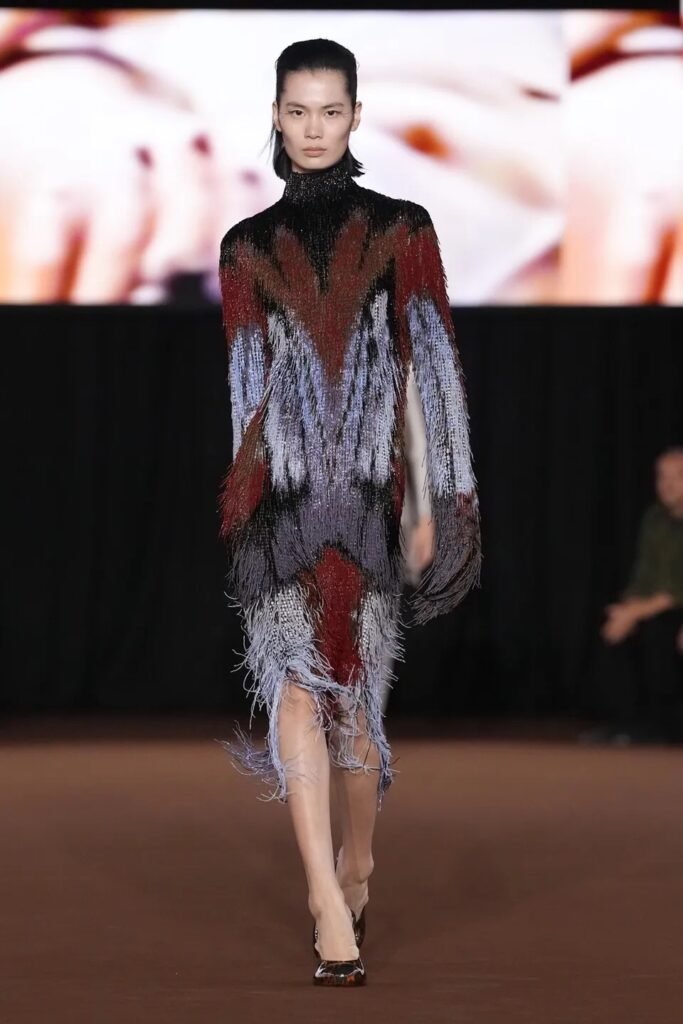
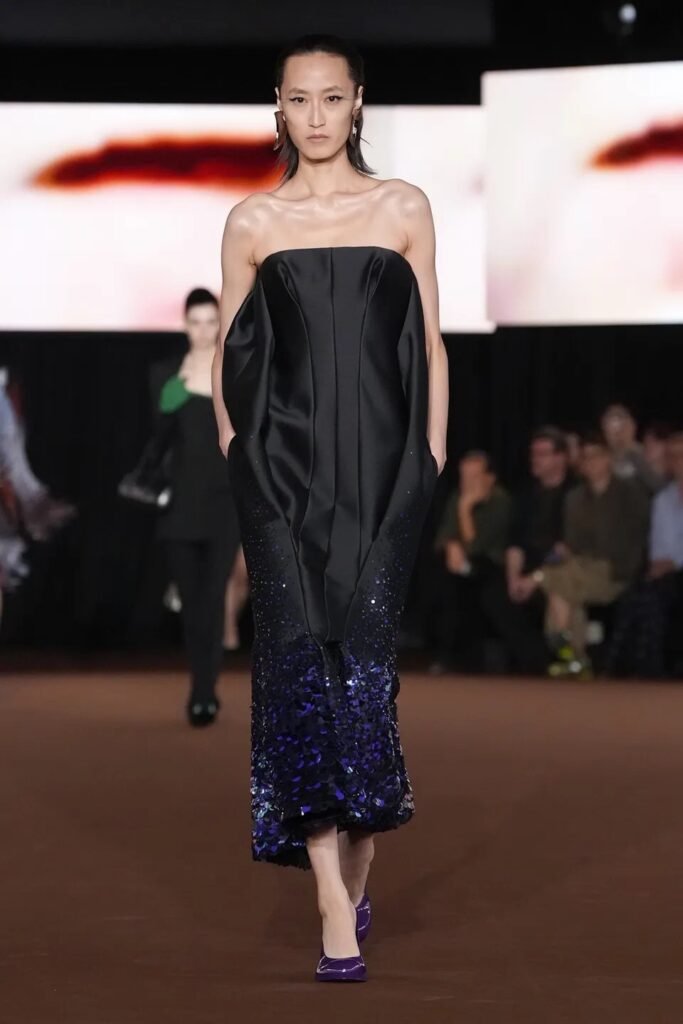
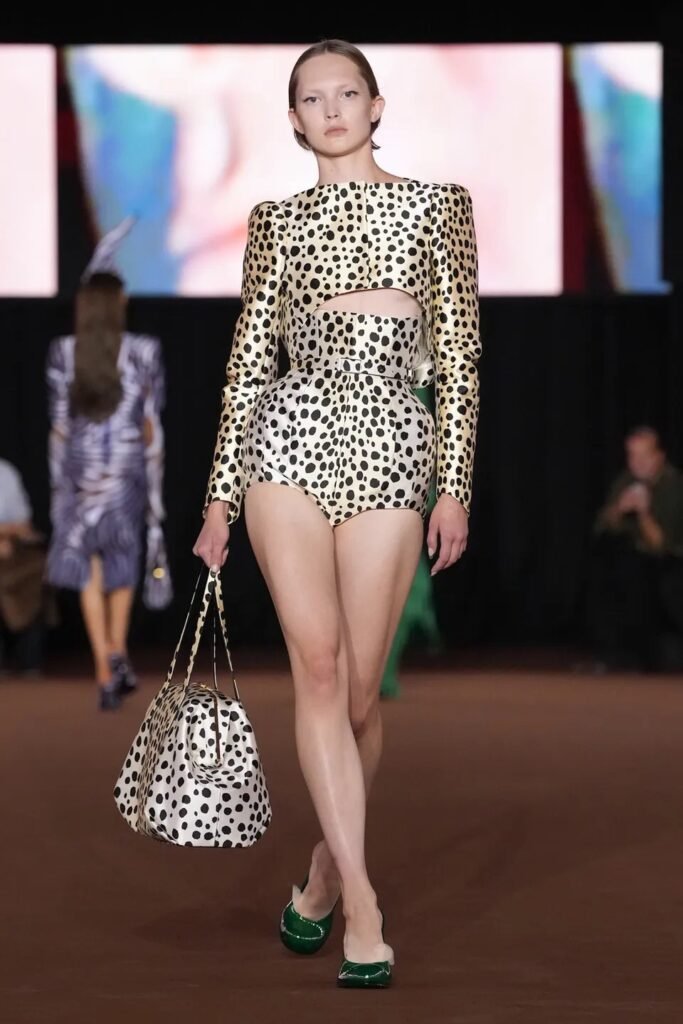
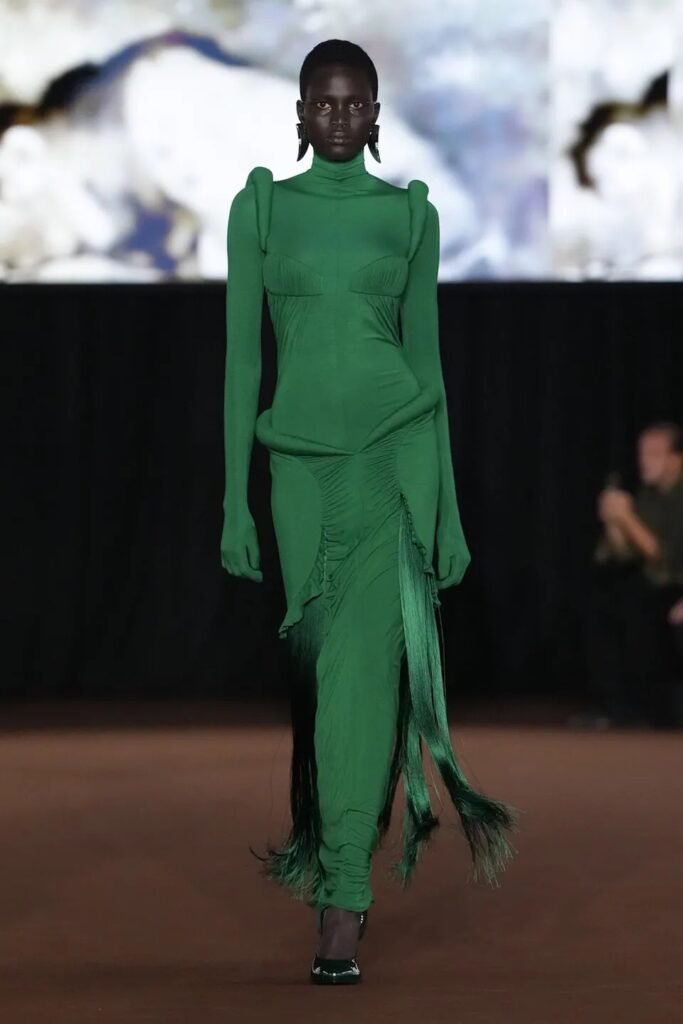
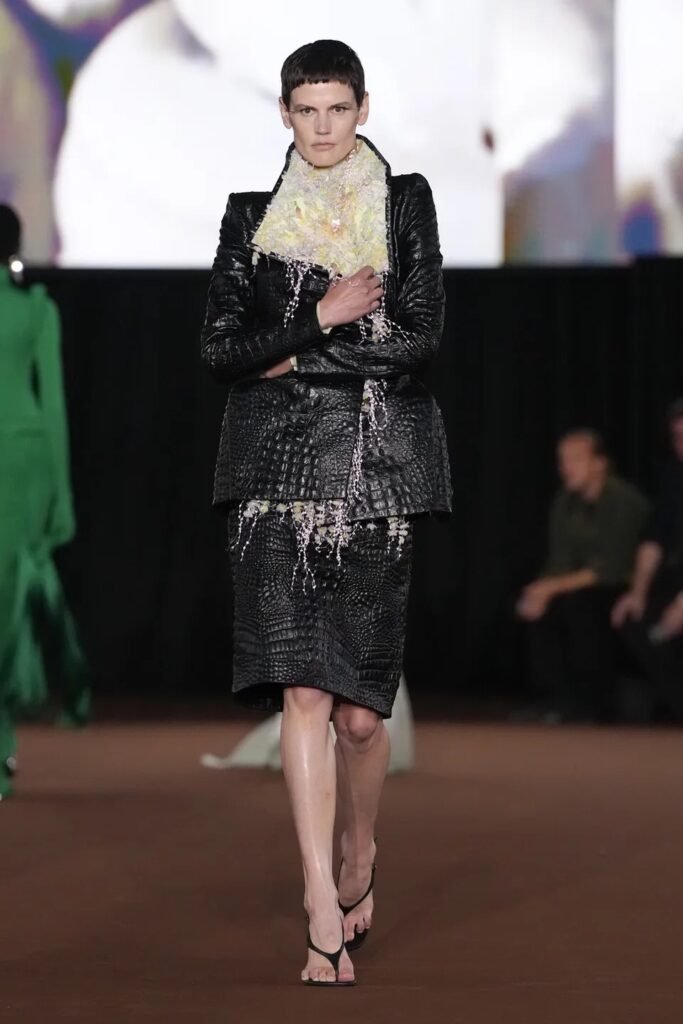
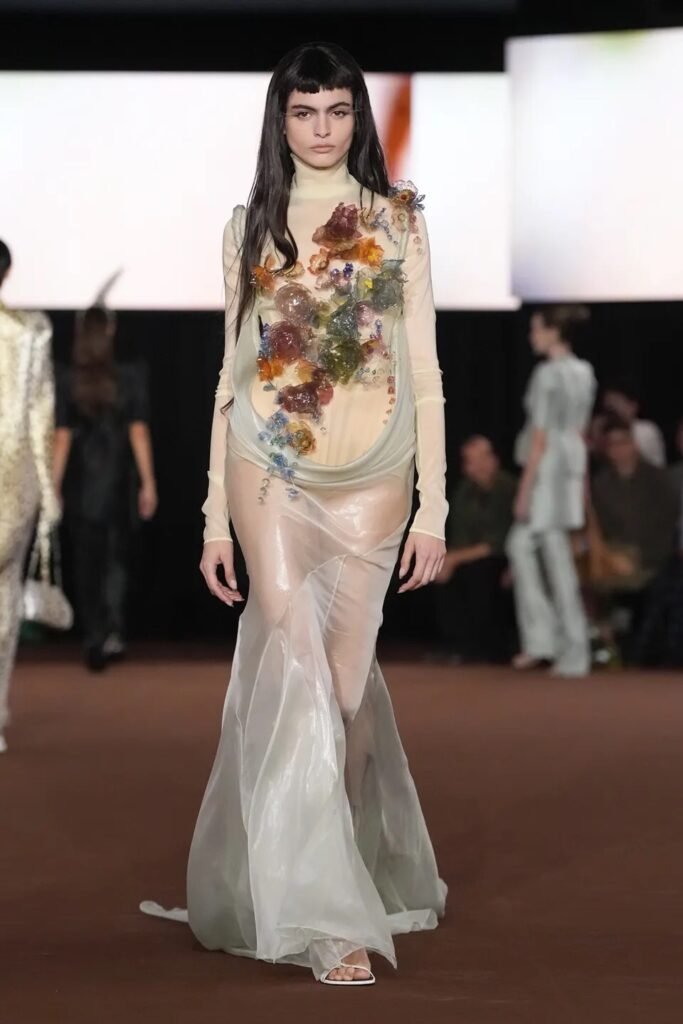
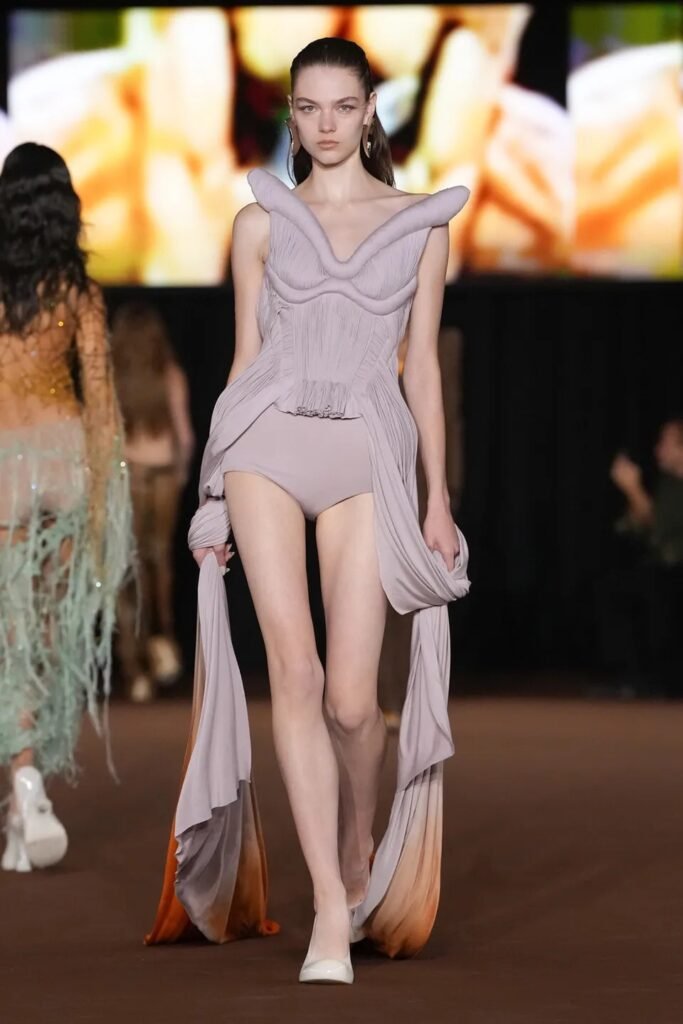
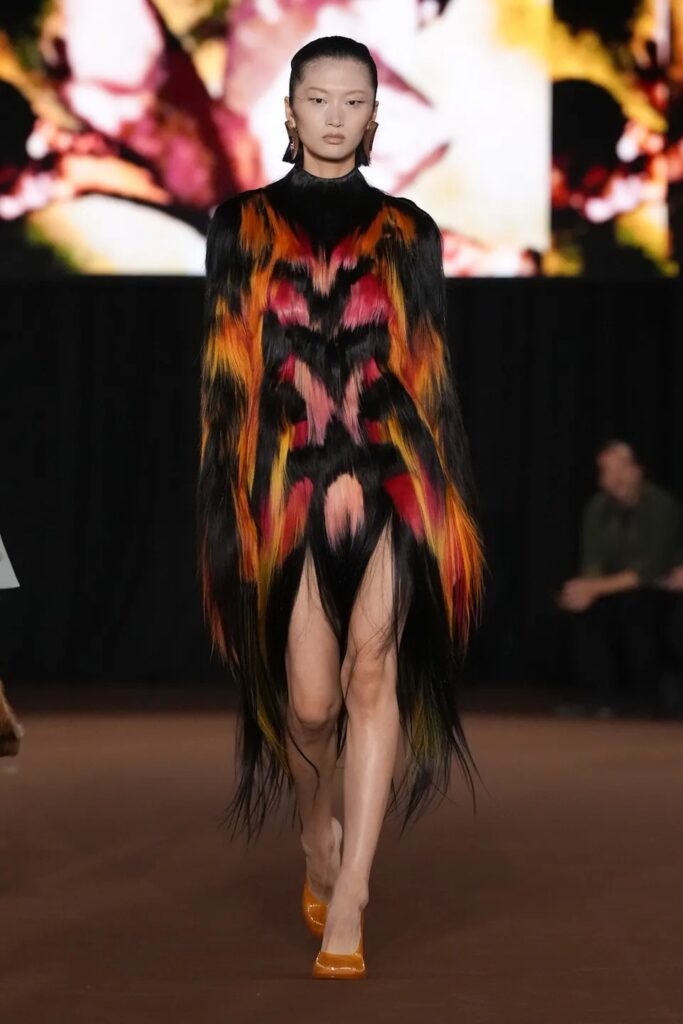
The result is a collection that feels unmistakably Mugler without simply looking backward. Flowers become distorted. Animal prints are magnified. Skin becomes an experimental surface. Tailoring takes on sculptural proportions, while eveningwear embraces feathers, fringe and fantastical embellishment.
It is nature, but nature seen through a Mugler lens.
Miguel Castro Freitas Enters Mugler’s World
Since being appointed Creative Director of Mugler in April 2025, Miguel Castro Freitas has approached the house’s extraordinary archive with an interest in transformation rather than straightforward nostalgia. The official Fédération de la Haute Couture et de la Mode profile identifies Freitas as the house’s Artistic Director, with his appointment coming after a period of transition for Mugler.
For Spring 2027, that approach becomes particularly clear.
Freitas looks toward elements that were important to Manfred Thierry Mugler but are sometimes overshadowed by the designer’s famous sculpted hourglass silhouettes. Instead of concentrating exclusively on the 1980s and 1990s, the collection reaches further back toward the 1960s.
The influence of the Space Age is particularly important.
The collection draws upon the futuristic imagination of the 1960s, when designers such as André Courrèges and Pierre Cardin were redefining the possibilities of fashion through technology, geometric silhouettes and visions of the future. Freitas connects that history with Mugler’s fascination with nature, creating a world where flowers, animals, humans and machines seem to merge.
Nature Becomes Something Otherworldly
Nature is the central character of Mugler Spring 2027.
But this is not a soft or romantic interpretation of the natural world.
Freitas magnifies flowers, insects, birds and animal patterns until their original forms become almost unrecognizable. The collection asks the viewer to look closer—and then question what they are actually seeing.
The result is deliberately psychedelic.
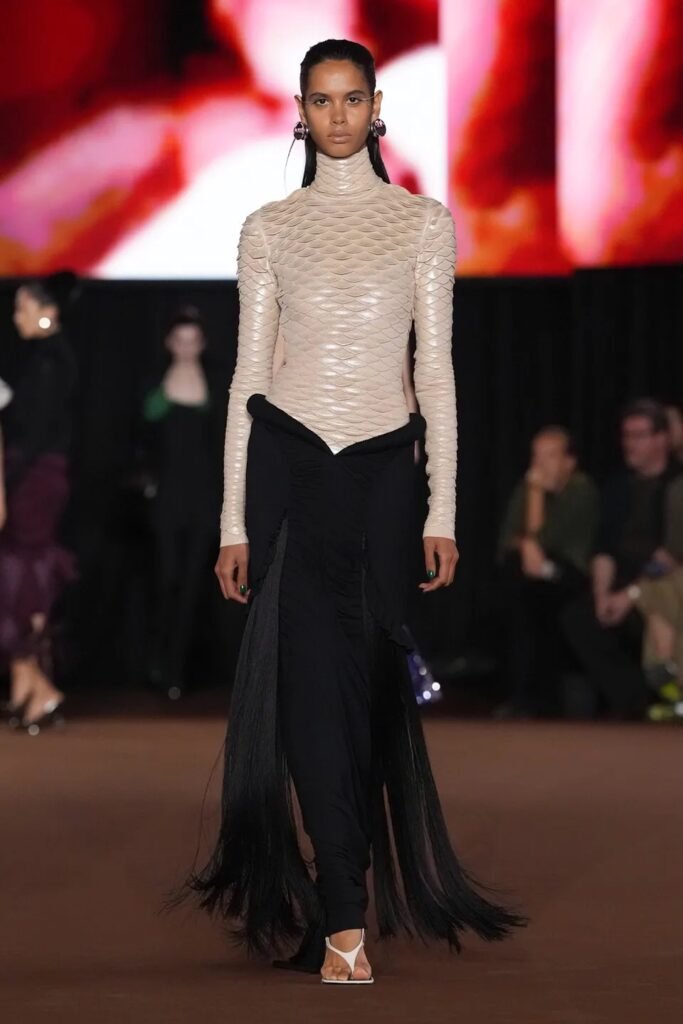
On the runway, organic shapes appear as futuristic textures, while floral and animal references become abstract visual experiments. One ivory second-skin top appears to transform the body into an almost scaled surface, while animal-like textures and fur introduce a more primal dimension.
This idea of transformation is essential to the collection.
Mugler’s Spring 2027 woman is not simply wearing nature. She becomes part of it.
The Butterfly Effect
The butterfly is another important reference within the collection’s visual language, particularly through its connection to transformation.
Björk, one of the most distinctive artists associated with Mugler’s history and visual culture, became an especially powerful symbol for the collection. On the same day the Spring 2027 collection debuted in Paris, the Icelandic artist appeared in Poland wearing a look from the new collection: a butterfly-print top styled with a high-waisted corseted skirt and a vintage feathered headpiece from Mugler’s 1997 haute couture archive.
The connection feels almost perfectly Mugler.
Björk’s relationship with fashion has always involved transformation, experimentation and a refusal to exist inside conventional boundaries. Her presence therefore reinforces the collection’s larger conversation about metamorphosis and self-expression.
Zebra Prints Get a New Life
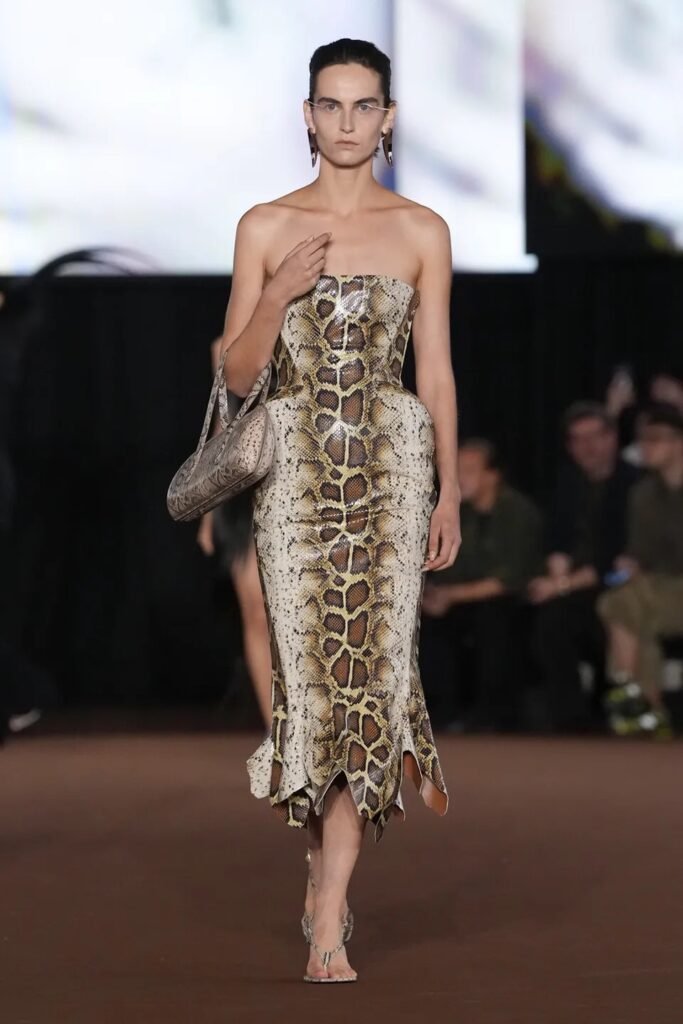
Animal prints return with considerable force for Spring 2027.
Rather than treating leopard or zebra as familiar fashion staples, Mugler turns them into full visual worlds.
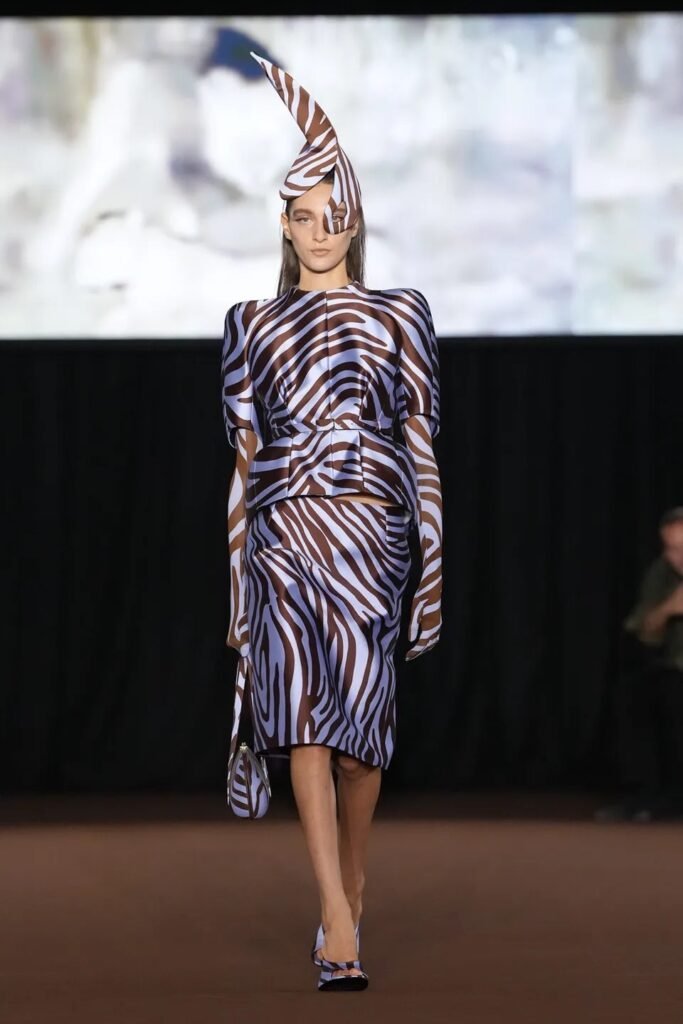
A zebra motif stretches across a tailored skirt suit, extending through accessories and footwear. The coordinated treatment makes the print feel less like an accent and more like an entire identity.
Elsewhere, animal-inspired textures collide with structured tailoring and futuristic silhouettes.
The effect is deliberately excessive.
This is not quiet luxury. This is Mugler at its most theatrical—where a print can become architecture and an accessory can become part of the character.
Sculptural Tailoring
Tailoring remains one of the strongest elements of the collection.
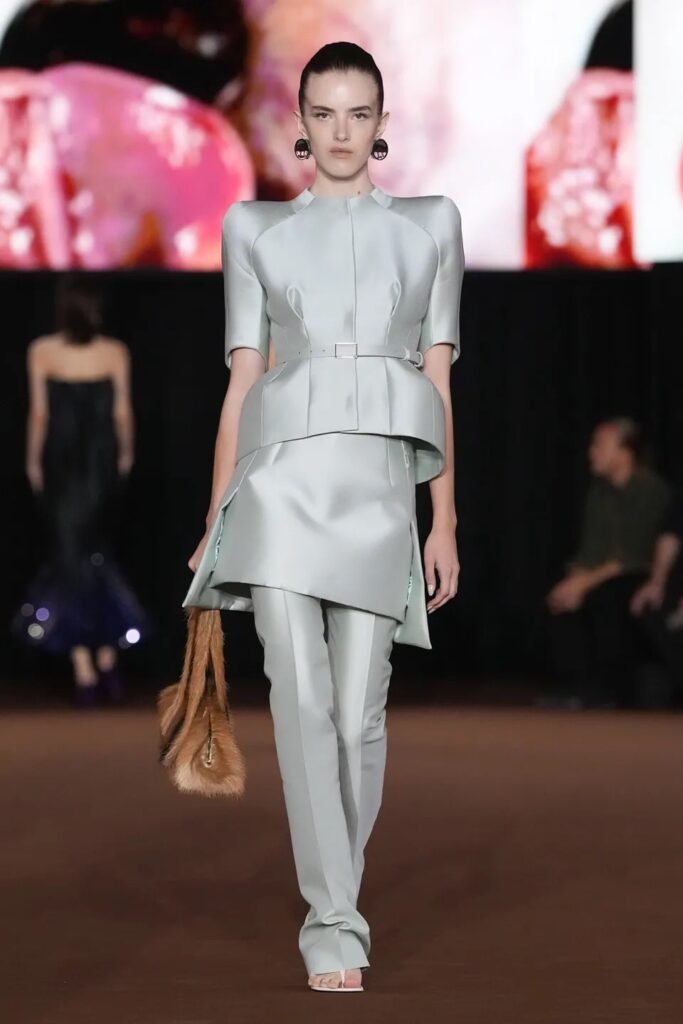
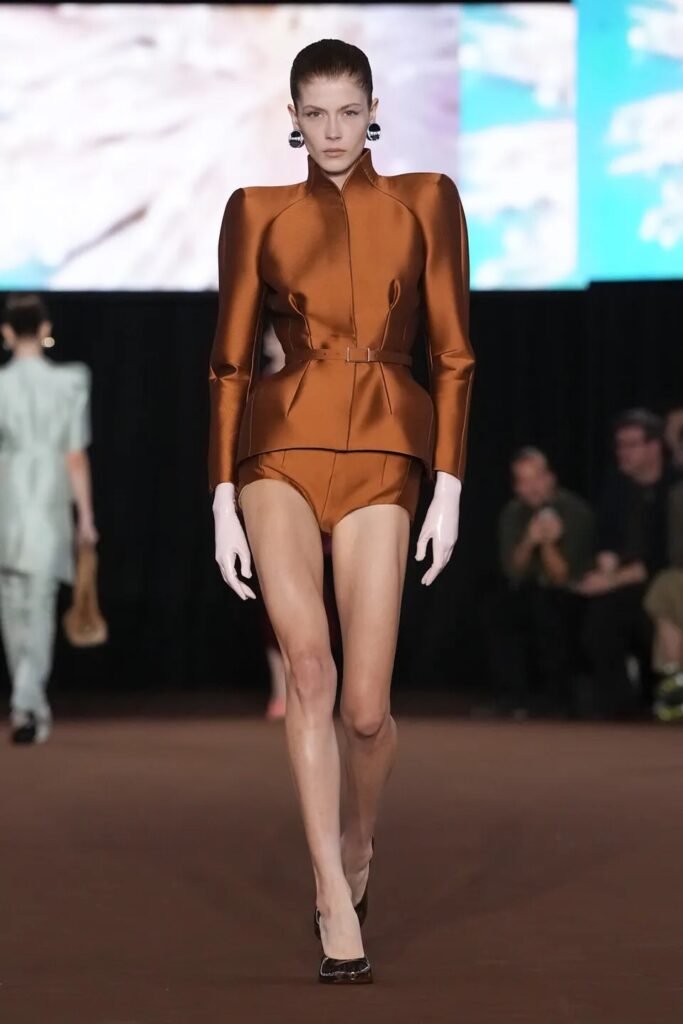
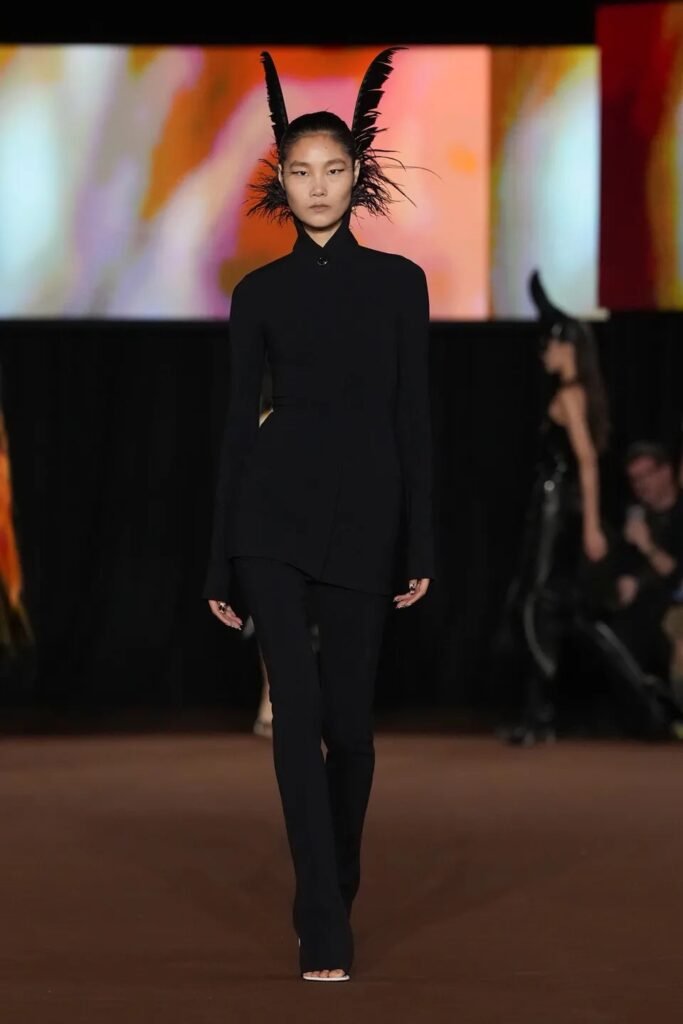
Mugler’s signature relationship with the body is translated into sharply constructed jackets, defined shoulders and close-fitting silhouettes. A number of looks demonstrate how Freitas balances rigid construction with movement.
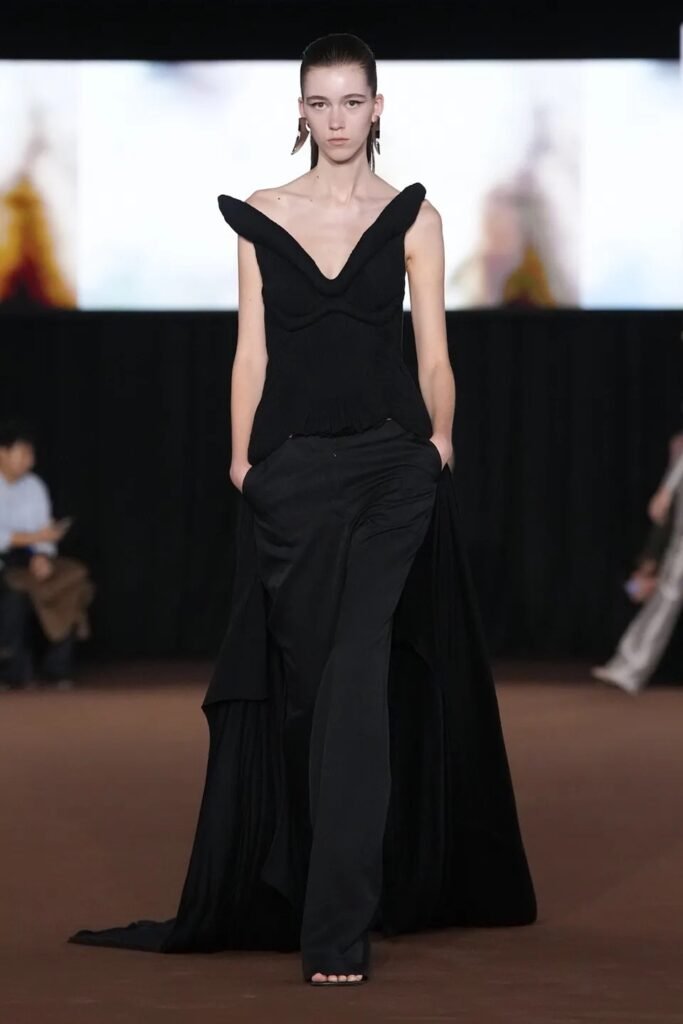
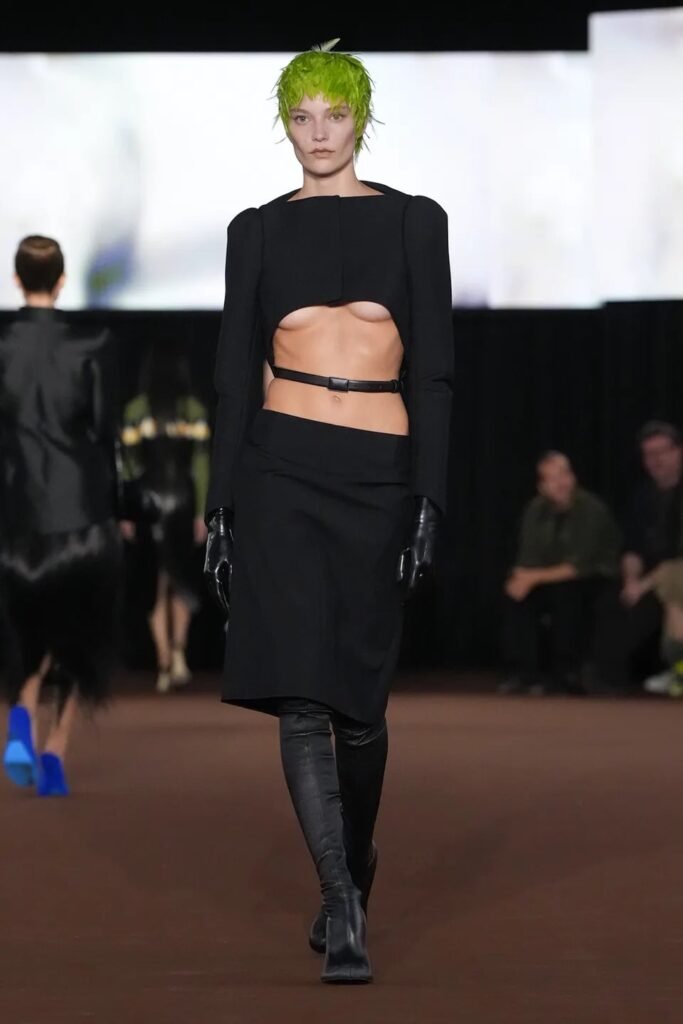
One striking black look combines a sleeveless, structured top with trousers featuring a long, flowing panel that trails behind the model. The contrast between the controlled upper silhouette and the dramatic movement below gives the look an almost ceremonial quality.
Elsewhere, tailored suits are reimagined through glossy satin, fitted proportions and unexpected colour.
The body remains central, but the clothes do not simply follow its contours. They reshape them.
The Return of Space-Age Glamour
The futuristic side of Mugler comes alive through the collection’s references to the 1960s.
High beehive hairstyles, close-fitting tailoring, glossy fabrics and sharply defined silhouettes create an atmosphere that feels simultaneously retro and futuristic.
It is a reminder that Mugler’s idea of futurism has never been exclusively about technology. It is also about fantasy.
The collection looks at a period when designers imagined the future through metallic surfaces, sculptural clothing and radical silhouettes—and translates that optimism into something more contemporary.
A fitted olive trouser suit, for example, channels the polished precision of 1960s tailoring, while a cropped satin variation introduces a more provocative attitude through a low-slung waist, exposed skin and matching latex gloves.
Eveningwear Embraces Fantasy
If tailoring gives the collection its structure, eveningwear provides its drama.
Mugler’s Spring 2027 dresses move away from conventional glamour and toward something more fantastical.
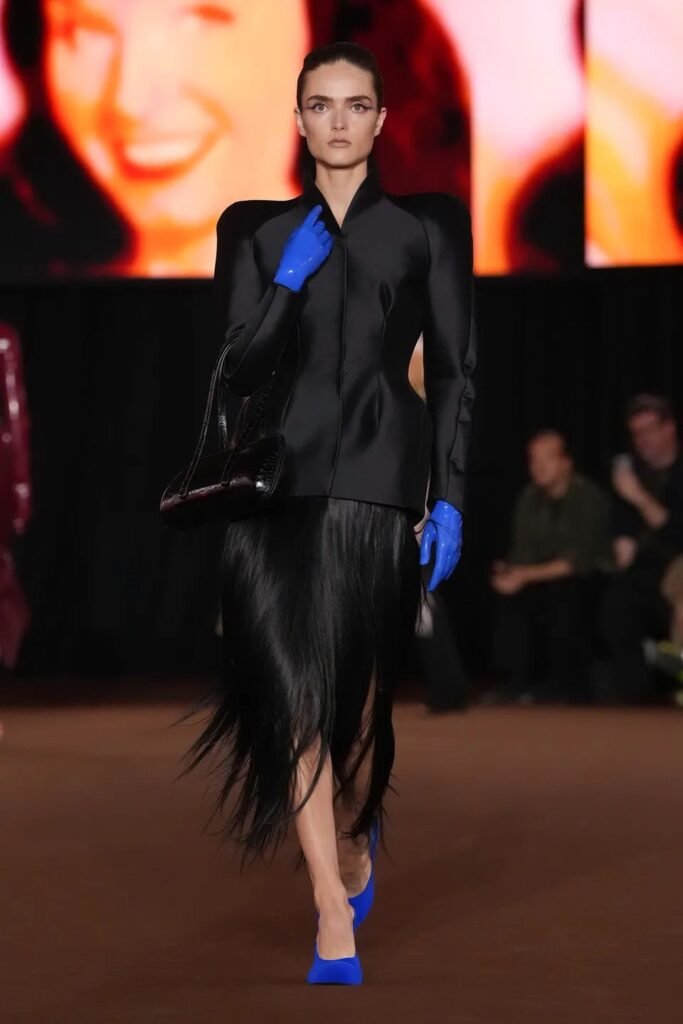
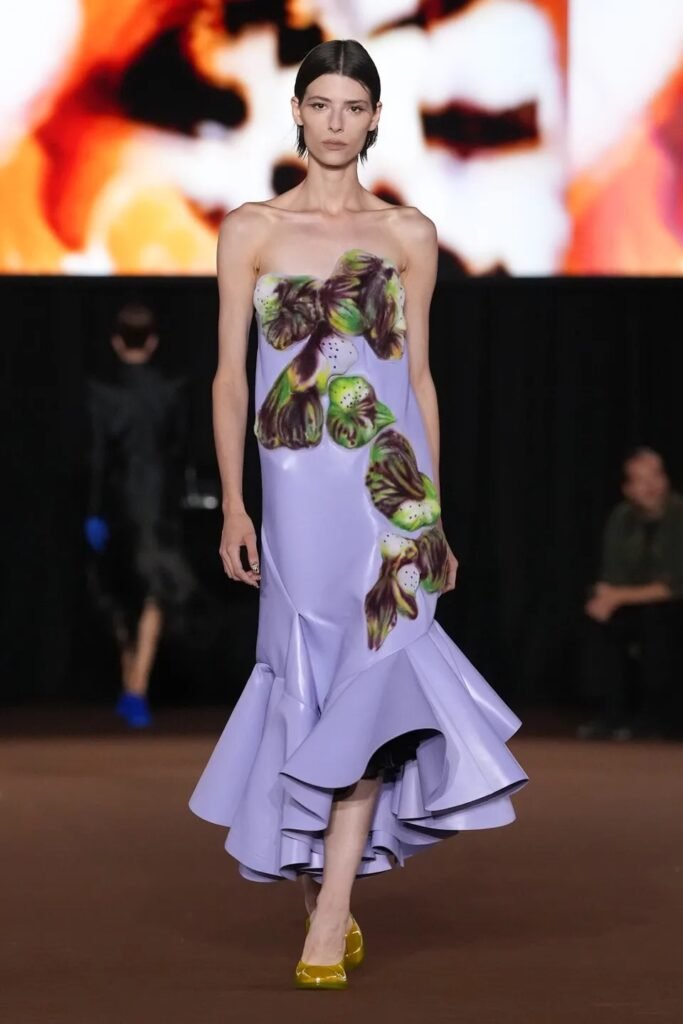
One of the collection’s most striking ideas involves fuzzy purple and yellow orchid-like forms appearing to bloom across the body of an evening dress. Elsewhere, long strands of hair-like material become a skirt beneath a structured blazer, creating an unusual collision between fashion and the natural world.
These looks demonstrate Freitas’s ability to make craftsmanship feel strange and exciting.
Rather than simply decorating the garment, the embellishment changes how the garment is perceived.
A flower becomes part of the silhouette.
Hair becomes fabric.
Animal markings become tailoring.
The boundaries keep disappearing.
From Manfred Thierry Mugler to a New Generation
The biggest challenge facing any designer at Mugler is the extraordinary legacy of Manfred Thierry Mugler.
His clothes were theatrical, body-conscious and unapologetically glamorous. His runway shows were spectacles, and his approach to fashion helped establish the idea of the fashion show as performance.
Freitas does not attempt to reproduce that exact formula.
Instead, he looks for less obvious connections.
The Spring 2027 collection’s fascination with the 1960s, technology, psychedelia, animals, flowers and futuristic silhouettes reveals a broader understanding of Mugler’s history. Freitas has described Manfred’s relationship with the 1960s as particularly significant, noting the designer’s interest in the technological and Space Age culture of the period.
That distinction matters.
Rather than recreating an archive, Spring 2027 uses the archive as a starting point.
A Collection About Transformation
Transformation may ultimately be the best word for Mugler Spring 2027.
The collection repeatedly asks what happens when one thing becomes another.
A flower becomes an abstract print.
A human body becomes an animalistic surface.
Tailoring becomes sculpture.
A vintage reference becomes futuristic.
Nature becomes technology.
Technology becomes fantasy.
This sense of metamorphosis also connects strongly with the atmosphere surrounding the show. At the Louvre’s Carrousel, the presentation incorporated imagery of enlarged flowers and lips, while artist Alexis Stone appeared in the guise of Manfred Thierry Mugler, creating an uncanny visual return of the house’s founder.
It was an appropriate setting for a collection obsessed with transformation.
Mugler Spring 2027 Is Fashion as Fantasy
Mugler Spring 2027 is not interested in minimalism.
It is interested in spectacle.
There are sharply tailored suits, sculptural shoulders, second-skin garments, zebra prints, fur-like textures, latex, feathers, dramatic eveningwear and surreal floral embellishments. Yet underneath the visual excess is a coherent idea: the natural world can be transformed into something unfamiliar.
That is where Freitas finds his most compelling Mugler language.
The collection feels connected to the house’s history without being trapped by it. It respects the visual vocabulary that made Mugler famous while introducing a more psychedelic, organic and experimental perspective.
For Spring 2027, Mugler does not ask us to choose between nature and technology, past and future, beauty and strangeness.
It embraces both.
And perhaps that is exactly what makes Mugler such a fascinating fashion house today.
Mugler Spring 2027 Ready-to-Wear is a celebration of transformation—where flowers become surreal, tailoring becomes sculpture and the human body becomes the starting point for an entirely new fantasy.