
|
Getting your Trinity Audio player ready… |
By Rei Kawakubo
There are few designers who can make fashion feel as intellectually charged as it looks visually extraordinary. For Spring 2027, Rei Kawakubo once again pushed Comme des Garçons beyond conventional ideas of beauty, elegance and wearability, presenting a collection that appeared to question the very nature of power.
The central clue came from Kawakubo herself: “When royal life and real life become one.” The sentence opened the door to a collection filled with crowns, monumental volumes, distorted surfaces and surreal constructions. Yet, as with much of Kawakubo’s work, the meaning was deliberately left unresolved.
Was this a celebration of royalty? A criticism of power? A fantasy about contemporary rulers? Or an examination of what happens when the theatrical world of monarchy collides with everyday life?
For Comme des Garçons Spring 2027, the answer seemed to be all of the above.
The collection was presented in Paris on October 3, 2026, with Kawakubo continuing her long-running practice of treating clothing as sculpture, performance and social commentary simultaneously.
Rei Kawakubo Turns Royalty Into Avant-Garde Fashion
Royal fashion traditionally communicates status through recognizable symbols: crowns, gowns, ceremonial fabrics, elaborate embroidery and exaggerated silhouettes.
Kawakubo took those familiar codes and dismantled them.
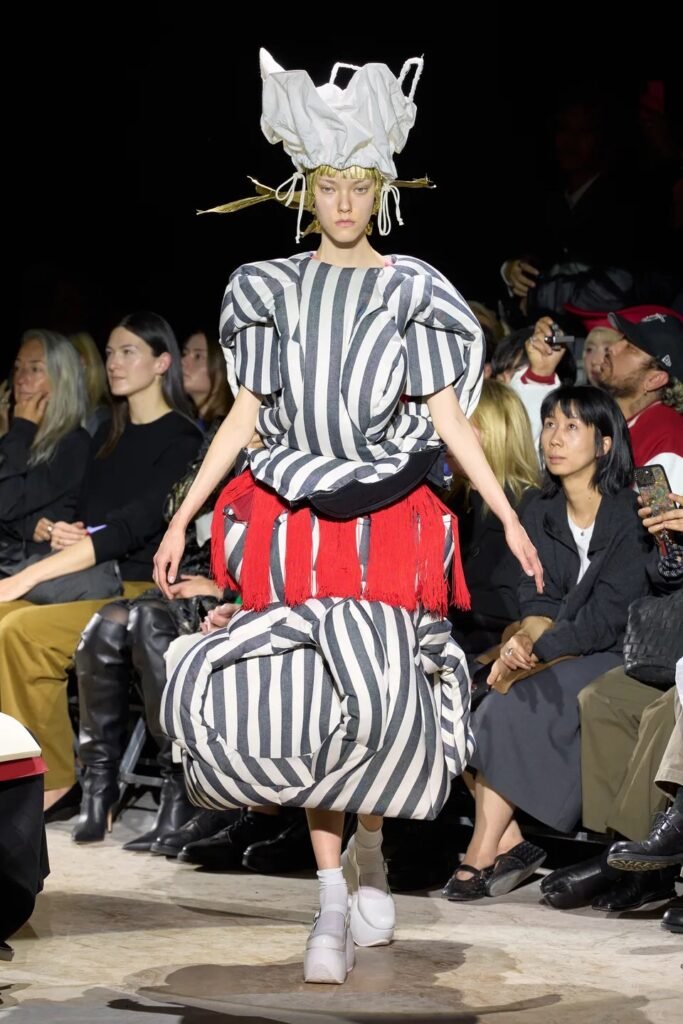
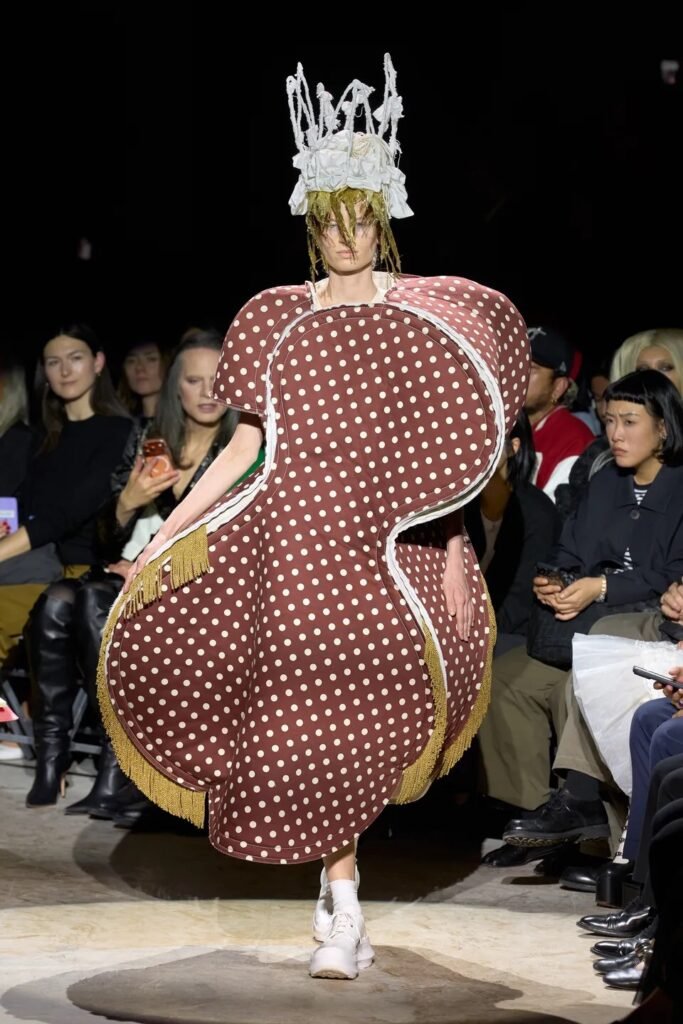
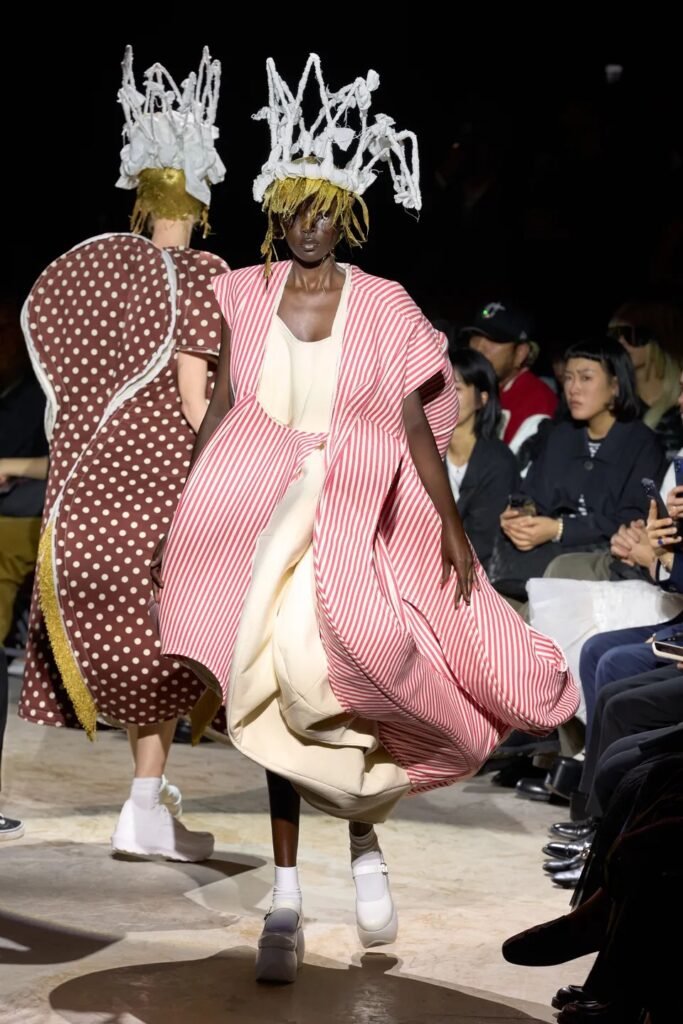
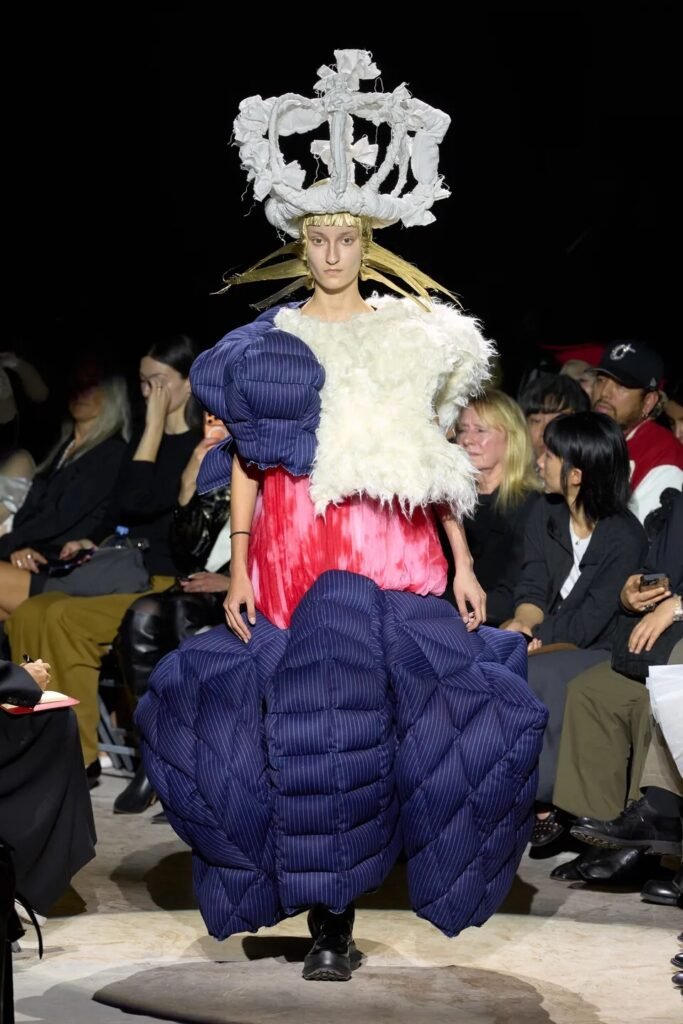
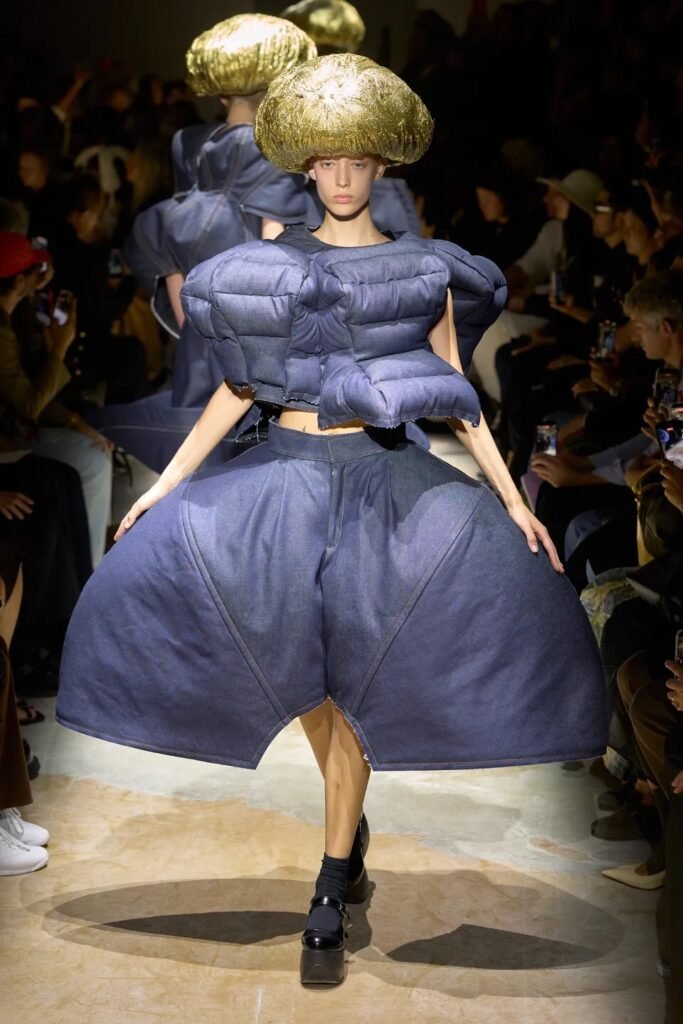
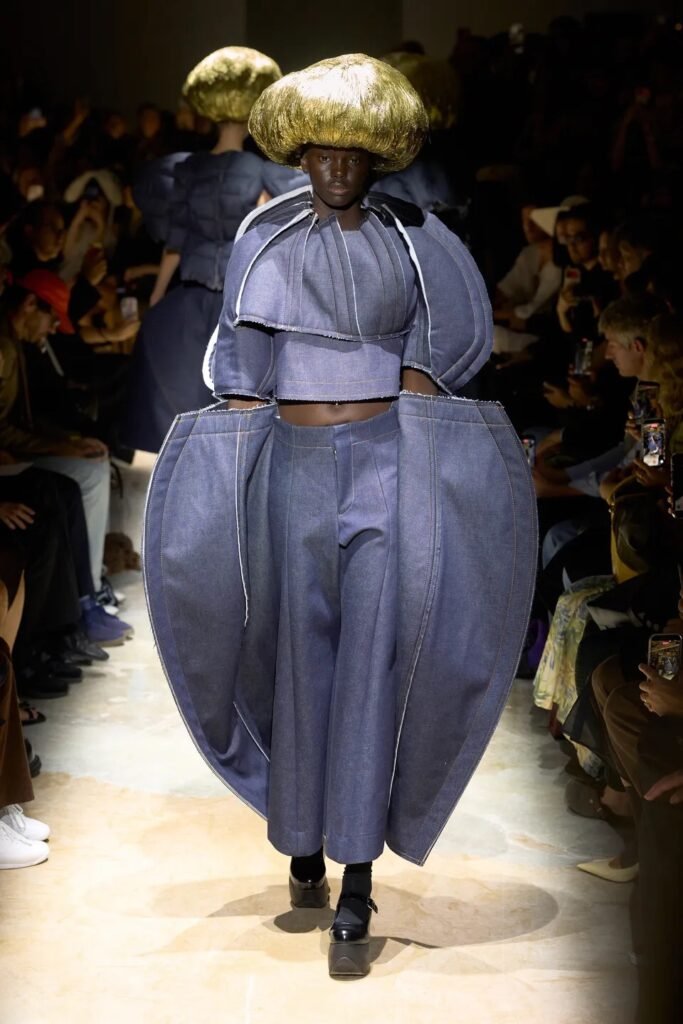
Every look in the first major section of the collection was topped with an abstract crown, constructed from padded cotton and wire. Rather than looking like traditional royal headwear, the crowns appeared almost primitive and architectural objects that seemed to question the authority they represented.
The effect was distinctly Comme des Garçons.
Instead of creating clothing that simply makes the wearer appear regal, Kawakubo asked what royalty might look like if its symbols were stripped of their familiarity.
The result was strange, theatrical and occasionally unsettling.
The models became almost otherworldly figures, carrying enormous sculptural objects while their bodies disappeared beneath layers of manipulated fabric and exaggerated forms.
Sculptural Silhouettes Take Over the Runway
Volume has always been an important part of Kawakubo’s design vocabulary, and Spring 2027 pushed that language into particularly dramatic territory.
The silhouettes expanded outward, creating shapes that sometimes resembled architectural structures, collapsed furniture or strange creatures.
One of the most memorable constructions was a spherical denim skirt, which Vogue’s Sarah Mower compared visually to an enormous pumpkin. Beneath its jagged openings, flashes of red fabric appeared like something attempting to escape from inside.
This tension between clothing and sculpture defined much of the collection.
Rather than allowing garments to follow the natural contours of the body, Kawakubo distorted them. Skirts became objects. Jackets became structures. Fabrics appeared to collapse, expand and erupt around the wearer.
It was less about dressing the body and more about completely reconsidering what clothing could do to the body.
Crowns, Monsters and the Dark Side of Power
The royal references became increasingly darker as the collection progressed.
There were exaggerated layers of faux hair, feathers emerging from structured forms and silhouettes that suggested historical court dress without directly reproducing it.
Furnishing-inspired fabrics added another layer to the fantasy. Ticking stripes, oversized gingham, brocade-like surfaces and polka dots appeared in forms that looked almost like pieces of an enormous, decaying palace.
The collection therefore created an unusual contradiction.
Royal imagery is supposed to communicate perfection.
Kawakubo’s version communicated instability.
Her crowns looked less like symbols of glory and more like objects belonging to an unfamiliar civilization. Her monumental garments suggested wealth and ceremony while simultaneously appearing uncomfortable, chaotic and almost monstrous.
That contradiction is where the collection became particularly compelling.
The Face Disappears
One of the most haunting moments involved a look featuring a curtain of blonde hair accompanied by ceremonial golden tassels.
The effect suggested the presence of a young woman without actually revealing her face.
It was an unusually powerful image because royalty is often built around visibility. Monarchs are photographed, painted, crowned and displayed.
Here, Kawakubo concealed the individual.
The person disappeared behind the symbolism.
The garment became more recognizable than the human being wearing it.
That idea can be read as a commentary on the relationship between identity, status and power: when someone becomes a symbol, how much of the individual remains?
Comme des Garçons has always been fascinated by that tension between the body and the object, and Spring 2027 transformed it into something almost theatrical.
Red Becomes a Warning
As the collection moved toward its conclusion, the visual language became increasingly intense.
Red ruching, strips of red tape and an encasing exoskeletal structure introduced an almost visceral quality. Eventually, the red elements suggested something closer to exposed internal organs than conventional decoration.
The progression was striking.
The collection began with crowns.
It moved through fantasy, ceremony and exaggerated beauty.
Then the symbols of power began to deteriorate.
The final images suggested that underneath the grandeur of royalty exists something much more vulnerable, physical and human.
It was an appropriately unsettling ending for a collection concerned with authority.
Denim Enters the Conversation
One of the more unexpected elements of the collection was denim.
Comme des Garçons is often associated with highly conceptual materials, dramatic tailoring and unconventional textile experimentation. The appearance of denim created a fascinating contrast with the more elaborate royal imagery.
But Kawakubo did not treat denim simply as casual clothing.
Instead, it became another material through which the collection’s sculptural language could operate.
The denim pieces maintained the same sense of distortion and volume as the rest of the collection, proving that even an everyday fabric could become something unfamiliar in Kawakubo’s hands.
This was not denim as wardrobe basic.
This was denim as sculpture.
Between Beauty and Discomfort
Perhaps the most fascinating aspect of Comme des Garçons Spring 2027 is its refusal to provide an obvious definition of beauty.
There were moments of extraordinary craftsmanship and visual beauty, but they were frequently surrounded by forms that appeared uncomfortable, excessive or deliberately strange.
That tension is central to Kawakubo’s approach.
Her clothes rarely ask to be conventionally admired.
Instead, they demand attention.
They make the viewer stop and question what they are looking at.
The collection’s silhouettes could be described as elegant, grotesque, regal, humorous and disturbing—sometimes within the same look.
That ambiguity is precisely what makes the collection feel so relevant.
What Does “Royal Life and Real Life” Mean?
Kawakubo’s statement—“When royal life and real life become one”—is intentionally open-ended.
One possible reading is that the designer was questioning the continued relevance of hierarchy in contemporary society.
The traditional monarch may wear a crown, but today’s most influential figures can also possess enormous power without one. Political leaders, billionaires and technology executives can exercise influence on a global scale.
The crown, therefore, becomes less a historical object and more a metaphor.
Who gets to rule?
Who gets to be seen as powerful?
And what happens when the symbols of authority become indistinguishable from ordinary life?
Kawakubo offered no straightforward answer.
Instead, she constructed an entire world around the questions.
Comme des Garçons Spring 2027 Is Fashion as Theatre
The collection demonstrates why Comme des Garçons remains one of fashion’s most important experimental houses.
While many runway collections begin with the question of what consumers might want to wear next season, Kawakubo often begins somewhere else.
She begins with an idea.
From there, fabric, silhouette, construction and styling become tools for expressing it.
Spring 2027 feels particularly theatrical because the clothes operate almost like characters in a play.
There is the queen.
There are the monsters.
There are the crowns.
There are hidden figures.
There is the palace.
And eventually, there is the collapse of the fantasy.
The runway becomes a stage, while the clothing becomes the scenery, costume and narrative simultaneously.
The Legacy of Rei Kawakubo Continues
More than five decades after founding Comme des Garçons, Rei Kawakubo remains one of fashion’s most uncompromising creative voices.
Her importance does not come simply from creating unusual clothes. It comes from demonstrating that fashion can exist outside the boundaries of conventional beauty, commercial practicality and traditional design.
Spring 2027 continues that philosophy.
The collection is not designed to give viewers an easy answer. Instead, it presents a visual puzzle about royalty, power, identity and the performance of status.
The crowns are beautiful but strange.
The silhouettes are spectacular but restrictive.
The fabrics reference luxury while looking damaged or distorted.
And the final red forms suggest that beneath every elaborate symbol of authority is something much more fragile.
That is the power of Comme des Garçons.
Rei Kawakubo does not simply design clothes for the next season.
She creates a world—and then asks us to decide what that world means.
Final Thoughts
Comme des Garçons Spring 2027 Ready-to-Wear is a powerful exploration of royalty and authority through Rei Kawakubo’s unmistakably avant-garde vocabulary.
With sculptural crowns, monumental silhouettes, distorted denim, theatrical fabrics, exaggerated volumes and increasingly visceral red details, the collection transforms the runway into an unsettling royal fantasy.
Yet beneath the spectacle is a more serious question: what does power look like when the symbols of royalty become part of everyday life?
Kawakubo leaves the answer deliberately unresolved.
And perhaps that is exactly the point.
In a fashion landscape increasingly obsessed with immediacy, trends and commercial appeal, Comme des Garçons continues to prove that a runway collection can still be a place for questions, contradictions and ideas.
Spring 2027 does not simply ask us to admire the clothes.
It asks us to look again.