


From a small luxury shop in Milan’s Galleria Vittorio Emanuele II to one of the most unforgettable names in global fashion, Prada’s history is a story of reinvention.
Founded in 1913 by Mario Prada, the house began with fine leather goods, travel accessories and luxury objects. More than a century later, Prada has become far more than a fashion label. It is a global luxury group, a cultural institution, an architectural force, an art patron, a technology collaborator and one of the fashion world’s most closely watched creative studios.
At the center of that transformation stands Miuccia Prada, whose arrival changed the meaning of the family business. Together with entrepreneur Patrizio Bertelli, she transformed a traditional Milanese leather goods company into a modern fashion empire built on an unusual challenge: that luxury does not necessarily have to look luxurious.
Prada made nylon desirable. It made awkwardness refined. It turned uniforms, workwear, school clothes, utilitarian fabrics and strategic ordinary garments into objects of fashion obsession. Its clothes have often asked consumers to reconsider what beauty is supposed to look like.
And that talent remains visible today.
In September 2026, Miuccia Prada and Raf Simons presented Prada Spring 2027 Ready-to-Wear, a collection almost entirely devoted to the skirt a remarkably simple garment treated as a canvas for discovery, decoration and personal expression.
More than a century after Mario Prada opened his first shop, the house is still asking the same essential question:
What happens when something familiar is looked at differently?
Prada Begins in Milan: 1913

The Prada story begins in 1913, when Mario Prada opened a luxury goods store in Milan’s prestigious Galleria Vittorio Emanuele II.
The location mattered.
The Galleria was and remains one of Milan’s great symbols of elegance, commerce and Italian culture. Its massive construction provided an appropriate setting for a business selling refined leather goods and luxury travel accessories.
Originally known as Fratelli Prada, the business rooted itself around craftsmanship and exceptional materials. Rather than beginning as a fashion house producing seasonal collections, Prada was initially a professional retailer of luxury objects: handbags, trunks, cases, accessories and other goods connected with luxury travel.
The company’s name grew quickly.
By 1919, Prada had been appointed an official supplier to the Italian royal family. The validation strengthened the company’s position among Italy’s wealthy and noble shoppers. The Prada Group notes that this period also added to the growth of the company’s visual identity, including the use of the knotted-rope design connected with the coat of arms of the House of Savoy.
The original Galleria store therefore became more than a shop. It represented the first chapter of what would one day become a global luxury empire.
Yet the Prada of the early twentieth century was at its core different from the Prada we all know today.
Its world was one of traditional luxury.
The uprising would come decades later.
From Family Business to Modern Fashion House
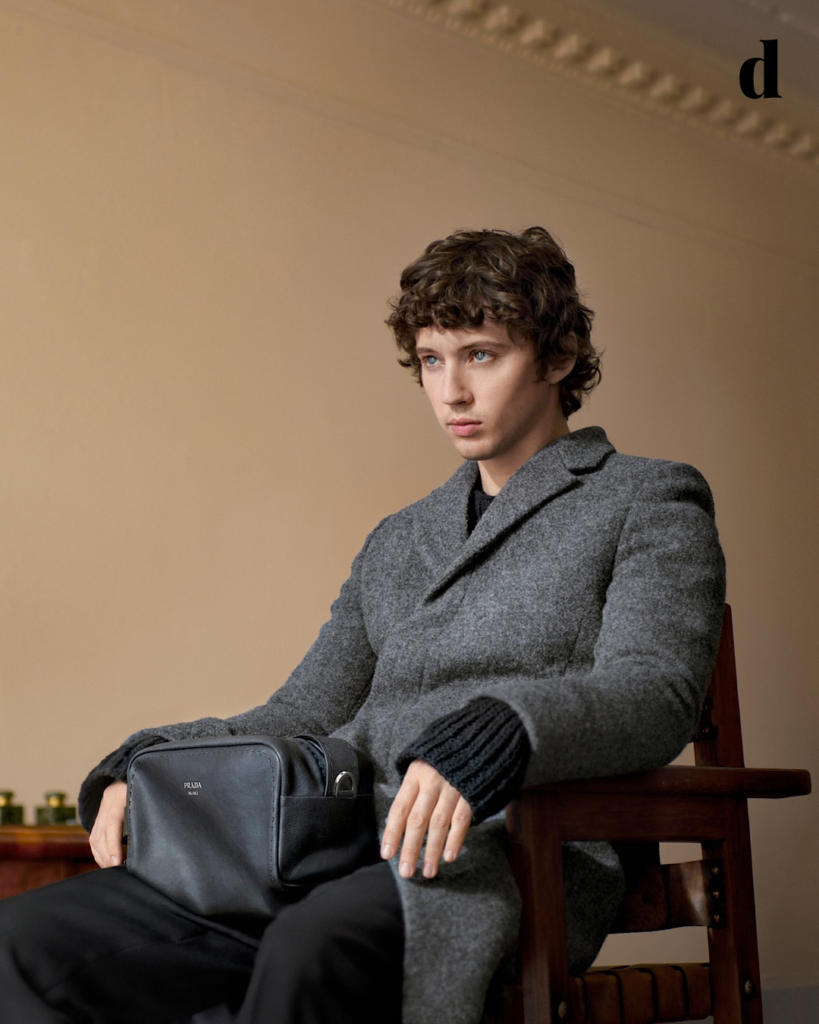
For much of its early existence, Prada remained rooted in leather goods and luxury accessories.
The business passed through generations of the Prada family, eventually reaching Miuccia Prada, Mario Prada’s granddaughter.
Miuccia’s relationship with the company would change everything.
She had studied political science at the University of Milan and had an interest in culture, politics and the arts rather than following the traditional path of a fashion designer. When she became involved in the family company, she brought a point of view that was much broader than traditional luxury merchandising.
Her approach was thoughtful, sometimes ironic and frequently conflicting.
Instead of simply asking how to make something beautiful, Prada‘s work began asking why something was considered beautiful in the first place.
That feature would become central to the brand.
Miuccia Prada and Patrizio Bertelli: The Partnership That Changed Prada


A essential turning point arrived in the late 1970s, when Miuccia Prada met entrepreneur Patrizio Bertelli.
Bertelli already had experience in leather goods and manufacturing. Their partnership combined Miuccia’s creative vision with Bertelli’s entrepreneurial and industrial expertise.
Prada itself describes the partnership as the beginning of a new business model for the worldwide establishment of the brand.
This was not simply a designer taking control of an old family company.
It was the building of a new kind of luxury business.
Miuccia could question fashion’s impressions. Bertelli could build the system required to turn those ideas into an international commercial operation.
Together, they would develop Prada into a straight up cohesive luxury company with its own manufacturing skills, retail network and expanding portfolio.
The creative and commercial sides of Prada were therefore never completely separate.
They evolved together.
That relationship remains essential to understanding Prada’s history.
The Nylon Revolution

If there is one material that represents Miuccia Prada‘s transition of luxury, it is nylon.
Today, Prada nylon bags are known around the world. But the idea of turning a unnatural, industrial-looking fabric into a luxury product was once deeply unconventional.
Traditional luxury depended heavily on materials such as leather, silk, cashmere and precious textiles.
Nylon belonged somewhere else.
It was connected with functionality, industry, uniforms and usefulness.
Miuccia Prada saw something different.
During the 1980s, Prada began introducing nylon into its accessories, particularly handbags. The result challenged traditional expectations about what a luxury bag was supposed to look and feel like.
The material was lightweight, durable and unmistakably modern.
Instead of hiding its industrial character, Prada highlighted it.
The famous black nylon became a visual language.
According to Prada Group, nylon became one of the defining expressions of Miuccia Prada’s approach to luxury, eventually extending beyond accessories into menswear and womenswear.
This was one of the most important intellectual shifts in modern luxury fashion.
Prada showcase that luxury could come from ideas, not merely expensive materials.
A nylon backpack could become desirable because of its design, cultural associations and relationship to the Prada name.
The house was effectively asking consumers to see ordinary materials differently.
That principle would influence fashion far beyond Prada.
Prada Enters Ready-to-Wear

The transformation from accessories company to fashion house intensified during the 1980s and early 1990s.
Prada began developing womenswear and established a distinctive design language that was increasingly removed from traditional ideas of glamour.
The clothes were intelligent rather than immediately seductive.
They could be rigid, strange, minimal, awkward, elegant or deliberately plain.
Sometimes they were all of these things at once.
Prada’s fashion did not necessarily attempt to make the wearer look traditionally beautiful.
Instead, it often made the wearer look interesting.
This distinction became one of Miuccia Prada’s greatest contributions to fashion.
At a time when luxury fashion could be defined by obvious glamour, status symbols and dramatic silhouettes, Prada offered something quieter but no less powerful.
The brand’s clothes suggested that Elegance could exist in restraint.
And that ugliness could be transformed into beauty.
The Prada Aesthetic: Ugly, Beautiful and Everything Between

The term “ugly chic” became closely associated with Prada during the 1990s.
But reducing Prada to “ugly” misses the depth of what Miuccia Prada was doing.
The point was not simply to make unattractive clothes.
It was to challenge the boundaries of taste.
Prada could take something associated with the ordinary brown, beige, nylon, utilitarian fabrics, school uniforms, sensible shoes, floral prints and place it into a luxury context.
Suddenly, the familiar became unfamiliar.
A demure silhouette could feel provocative.
A practical shoe could become fashionable.
A plain coat could carry more cultural weight than a extravagant evening gown.
Prada’s influence therefore extended beyond individual garments.
It changed the way designers, editors and consumers thought about fashion itself.
Fashion could be intellectual.
Fashion could be ironic.
Fashion could be uncomfortable.
Fashion could be about society rather than fantasy.
And fashion could be beautiful precisely because it refused to behave like traditional beauty.
Prada and Miu Miu: Two Sides of the Same Creative Mind


In 1993, Miuccia Prada introduced Miu Miu, named after her childhood nickname.
The new brand became a space for experimentation that could operate alongside Prada while maintaining its own identity.
Prada was increasingly associated with intellectual depth, modernism and conceptual tension.
Miu Miu could be younger, more playful, more provocative and more openly seductive.
The two brands became interlocking facets of Miuccia Prada’s creative universe.
The same designer could explore different sides of fashion without forcing every idea into a single brand identity.
That duality became one of the defining features of the Prada Group.
And Miu Miu would eventually become one of the world’s most culturally influential luxury brands in its own right.
Fondazione Prada: When Fashion Became Culture


1993 was also significant because it marked the establishment of Fondazione Prada.
This helped expand Prada’s identity beyond fashion.
The foundation became a major platform for present day art, exhibitions, architecture, cinema and cultural experimentation.
That investment showcased something important about the Prada worldview.
Fashion does not exist in isolation.
It interacts with art.
It interacts with film.
It interacts with architecture.
It interacts with photography, technology, politics and todays culture.
This cross-field thinking became increasingly visible throughout the Prada universe.
The brand’s stores were not simply retail environments.
Its campaigns were not simply advertisements.
Its runway shows could function as cultural statements.
And its spaces could become architectural destinations.
Prada’s Architecture Revolution


Few fashion houses have embraced architecture as extensively as Prada.
In 2001, Prada opened its first Epicenter in New York, designed by architect Rem Koolhaas and his firm OMA.
Rather than creating another traditional luxury boutique, Prada approached the store as an experimental cultural space.
The concept was afterward expanded through Epicenters in Tokyo and Los Angeles, with architecture becoming part of the brand’s identity.
The approach was significant.
Luxury retail was no longer simply about displaying products.
The environment itself became part of the Prada experience.
Architecture could create conversation.
Space could become storytelling.
A Prada store could feel closer to a gallery, cultural institution or architectural experiment than a conventional boutique.
This relationship between fashion and architecture would become one of the most noticeable features of the Prada world.
Prada and Sport: Linea Rossa and the America’s Cup


Prada’s interest in innovation also extended into sport.
In 1997, Prada launched Linea Rossa, its sportswear line.
The same year, Patrizio Bertelli‘s passion for sailing led to the creation of the Prada Challenge for the 2000 America’s Cup.
The sailing campaign introduced another dimension of Prada’s identity.
Performance.
Technology.
Engineering.
Precision.
These concepts matched naturally with the house’s interest in functional materials.
Prada‘s relationship with sport was therefore not simply a marketing exercise. It mirrored the company’s broader obsession with the meeting point between design and technical innovation.
That viewpoint would become increasingly important in later collaborations.
Building the Prada Group

As Prada’s fashion influence grew, the company also expanded commercially.
The Prada Group developed into a broader luxury organization through acquisitions, partnerships and new businesses.
In 1999, it acquired British footwear house Church’s.
In 2001, Italian driving-shoe specialist Car Shoe joined the group.
The company later expanded into other categories, including eyewear and fragrance through licensing agreements.
In 2014, Prada Group acquired Marchesi 1824, the historic Milanese pastry company founded in 1824.
At first glance, luxury footwear, fashion, eyewear, fragrance and Milanese pastry may seem unrelated.
But together they reveal a broader Prada viewpoint.
Luxury was not restricted to clothing.
It could be a lifestyle.
It could be an environment.
It could be food.
It could be architecture.
It could be art.
It could be a cultural experience.
Prada Goes Public

Another important moment in Prada’s business history arrived in 2011, when Prada S.p.A. became the first Italian company to be listed on the Hong Kong Stock Exchange.
The listing reflected Prada’s increasingly international identity.
The company was no longer simply a historic Milanese business.
Its customers, retail network, investors and cultural influence were global.
Yet the Milanese foundation remained central.
That combination Italian heritage with international ambition would become one of Prada’s defining strengths.
Prada and Sustainability: From Nylon to Re-Nylon

The same material that helped define Prada’s modern identity would later become part of its eco-friendliness conversation.
Prada developed Re-Nylon, using regenerated nylon made from recycled materials.
The project represented an attempt to rethink one of the house’s most recognizable materials for a changing fashion industry.
The relationship between Prada and sustainability has also expanded through broader environmental and social venture.
The Prada Group launched its SEA BEYOND educational program with UNESCO, focusing on ocean preservation. From July 2023, 1% of proceeds from the Prada Re-Nylon for SEA BEYOND collection supported the educational program.
This is particularly significant because Prada’s relationship with nylon has always been connected to the relationship between fashion and technology.
The material that once symbolized industrial modernity is now being reimagined through environmental responsibility.
The conversation has changed.
So has the material.
Prada Meets Space

Prada’s obsession with technology eventually reached beyond Earth.
In 2024, Prada and Axiom Space announced a partnership to develop spacesuits for NASA’s Artemis III lunar mission.
It was an extraordinary development for a fashion house that began by selling luxury trunks in Milan.
But at its core, it made sense.
The Prada universe has long been interested in the meeting of fashion, function, technology and design.
A spacesuit is clothing at its most extreme: a garment designed for survival, movement and environmental protection.
Prada’s involvement showcased how far the company’s definition of fashion had expanded.
From handbags.
To nylon.
To ready-to-wear.
To architecture.
To art.
And ultimately to the Moon.
Miuccia Prada and Raf Simons: A New Chapter


In 2020, Prada announced one of the most closely watched creative partnerships in modern fashion.
Raf Simons joined Miuccia Prada as co-creative director of Prada, with both designers assuming equal creative responsibilities.
It was unusual.
Fashion houses traditionally depend around a single creative director.
Prada created a different model.
Two influential designers.
One house.
Shared creative responsibility.
Simons brought his own history of working across minimalism, youth culture, tailoring, technology and conceptual fashion. Prada brought decades of experience and a deeply established visual language.
Rather than replacing Miuccia Prada, Simons entered into discussion with her.
The partnership has become one of the defining creative relationships of todays luxury fashion.
Their work frequently examines familiar objects and clothing categories.
What is a uniform?
What makes a garment desirable?
How can something ordinary become extraordinary?
How much can fashion change without losing its connection to real life?
These questions have remained remarkably consistent with Prada’s historical approach.
Prada in the 2020s: Looking Back to Move Forward

Prada’s present day collections have increasingly showcased an interest in fashion history.
But this is not nostalgia in the conventional sense.
Instead, the house often treats its archive as a laboratory.
Past Prada ideas are reconsidered, altered and reintroduced.
A familiar silhouette may return in a new material.
A historical print may be transformed.
A basic garment may become the central idea of an entire collection.
This approach reflects Prada’s broader viewpoint: the past is not necessarily something to preserve unchanged.
It is something to review.
Prada Spring 2027 Ready-to-Wear: The Skirt Becomes the Story
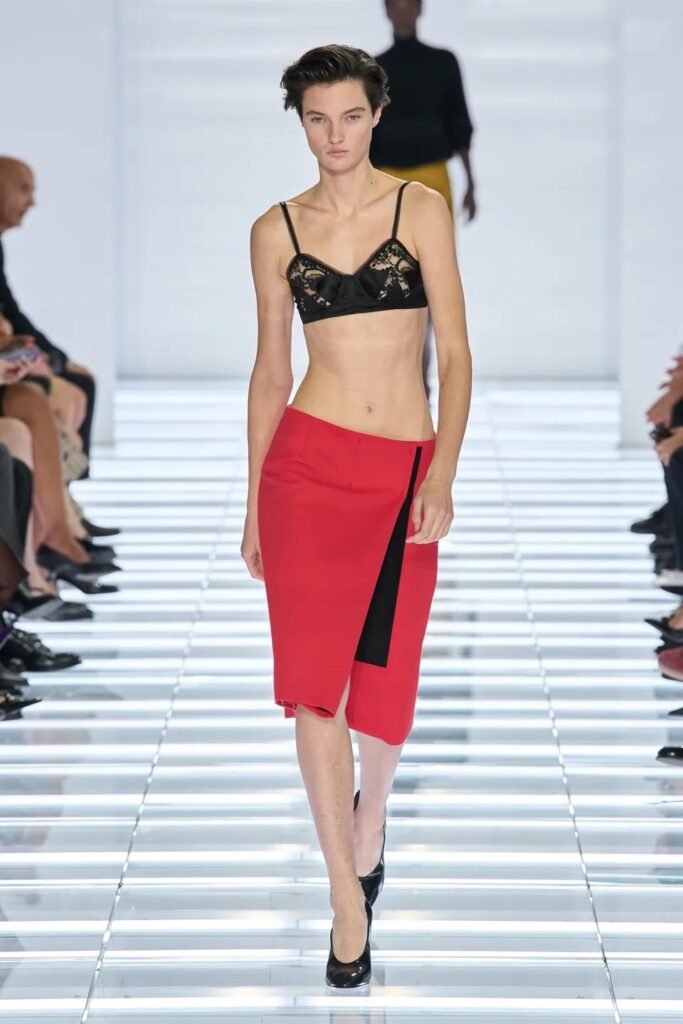
That idea came into sharp focus with Prada Spring 2027 Ready-to-Wear, presented in Milan in September 2026 by Miuccia Prada and Raf Simons.
The collection centered on one surprisingly ordinary garment:
the skirt.
The decision was rooted partly in a statement Miuccia Prada made during a 2006 interview with Ingrid Sischy, when she compared the skirt to a T-shirt because of its versatility.
Twenty years later, Prada and Simons returned to that idea.
The result was a collection of 63 looks built around skirts in different forms.
There were knee-length and mini silhouettes, pleated designs, printed styles, embellished skirts and more experimental constructions. Some became templates for decoration, while others explored technical materials and unexpected proportions.
There were also references to Prada‘s own history.
Nylon returned.
Floral patterns appeared.
Crinoline and ribbons entered the conversation.
Some designs included technical latex-like materials and coated cotton.
The collection also featured tiny bras worn as tops, creating a conversation between everyday styling and Prada’s own history, including homages to a 1995 Miu Miu collection built around bralettes and skirts.
It was an unusually focused collection.
Rather than introducing an endless list of new ideas, Prada and Simons focused on one garment and asked how many different ways it could be understood.
That is a very Prada approach.
Take something ordinary.
Question it.
Rework it.
Make it strange.
Then make it desirable again.
Why the Spring 2027 Collection Matters to Prada’s History
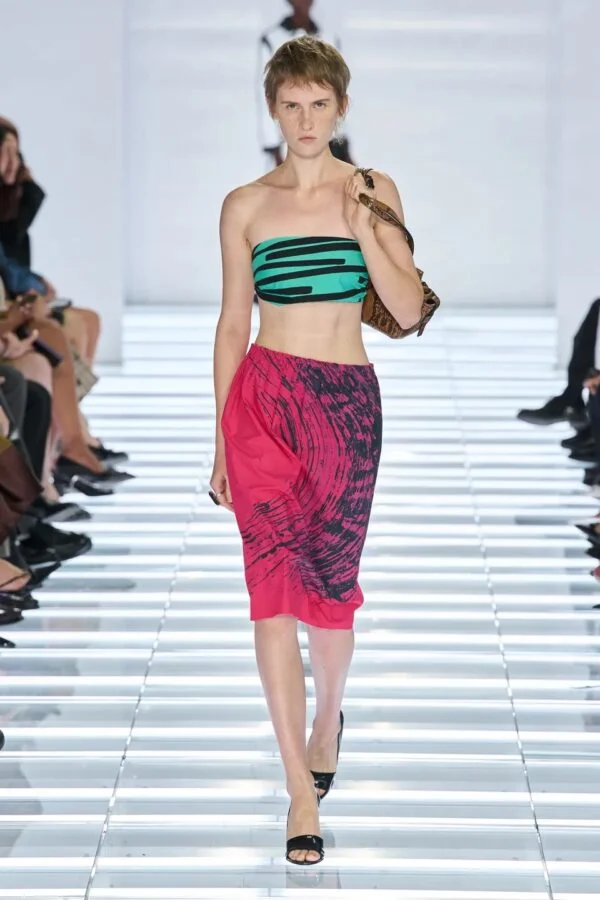


The significance of Spring 2027 is not simply that skirts are fashionable again.
The collection showcases how Prada continues to use its own history as creative material.
The house has never depended entirely on novelty.
Instead, it has repeatedly highlighted that breakthrough can come from reinterpreting what already exists.
The skirt has existed for centuries.
Prada did not invent it.
But Prada and Simons explored what happens when a familiar garment becomes a blank canvas.
That connects directly to one of the most important baselines of Prada’s history.
The nylon bag did not become game changing because nylon had never existed.
It became goundbreaking because Prada changed the context.
The same can be said of the skirt.
The garment is familiar.
The viewpoint is not.
Duru‘s coverage following the Spring 2027 show also highlighted the sharp increase in searches for Prada skirts on resale and shopping platforms, suggesting that the collection quickly translated into consumer curiosity.
Prada’s Business in 2026

While the fashion house remains creatively influential, Prada in 2026 is also a major global corporation.
Prada Group reported €5.718 billion in net revenues for 2025, representing a 9% increase year over year at constant currency, according to its March 2026 results announcement. Prada itself recorded a more flexible performance during the year, while Miu Miu continued to experience significant growth.
The group’s structure has also entered a new phase.
One of the biggest developments was the acquisition of Versace.
In April 2025, Prada Group announced an agreement to acquire 100% of Versace from Capri Holdings for an enterprise value of €1.25 billion. The transaction was completed in December 2025.
This is historically significant.
Prada began as a single Milanese luxury shop.
More than a century later, the group behind that name now owns another globally known Italian fashion house with its own powerful cultural identity.
The acquisition also showcases the changing structure of the luxury industry, where heritage houses are increasingly organized into larger groups capable of providing manufacturing, retail, technology and financial architecture.
Prada Group has stated that Versace would retain its creative DNA and cultural identity while benefiting from the group’s industrial and operational platform.
Prada’s Leadership in 2026

The Prada Group’s present day leadership reflects the company’s transition from founder-led family business to polished global corporation.
Miuccia Prada remains Prada co-creative director alongside Raf Simons and Miu Miu creative director.
Patrizio Bertelli serves as Prada Group chairman and executive director.
Andrea Guerra serves as chief executive officer and executive director.
Lorenzo Bertelli, the son of Miuccia Prada and Patrizio Bertelli, serves as Prada Group Chief Marketing Officer and Head of Corporate Social Responsibility and is also an executive director.
This creates an interesting combination of continuity and evolution.
The company remains deeply connected to the Prada family.
At the same time, its management structure has become increasingly commercialized and international.
Prada’s Cultural Influence

Prada’s importance cannot be measured only by sales.
Its influence on fashion culture is much larger.
Designers have absorbed its approach to materials.
Photographers have worked within its visual language.
Artists have collaborated with the brand.
Architects have shaped its stores.
Film directors have used Prada garments as cultural signifiers.
Celebrities have transformed Prada pieces into red-carpet statements.
And fashion consumers have learned to recognize a very specific type of elegance: one that does not necessarily announce itself.
Prada has also helped redefine the relationship between fashion and intellect.
Its shows are often discussed not only for their clothes but for the ideas behind them.
That thoughtful element is perhaps the brand’s most enduring contribution.
Prada and the Idea of Modern Luxury

What makes Prada’s history particularly fascinating is that the house has repeatedly questioned luxury while at the same time becoming one of luxury’s most powerful representatives.
That opposition is central to Prada.
Luxury traditionally suggests rarity.
Prada introduced ordinary materials.
Luxury traditionally suggests decoration.
Prada often embraced minimalism.
Luxury traditionally celebrates beauty.
Prada questioned beauty.
Luxury traditionally looks toward the future.
Prada constantly revisits the past.
And yet the result is still unmistakably luxurious.
This tension has allowed Prada to remain culturally relevant across generations.
The house does not simply sell products.
It sells a way of seeing.
From Galleria Vittorio Emanuele II to the Future

More than 110 years separate Mario Prada‘s first store from Prada’s Spring 2027 collection.
The physical distance between those two moments is massive.
The conceptual connection, however, is surprisingly strong.
Mario Prada built a business around craftsmanship, quality and elegant objects.
Miuccia Prada transformed that foundation by questioning what luxury could mean.
Patrizio Bertelli built the industrial and commercial backbone capable of taking that vision around the world.
Raf Simons joined the story by bringing another generation of fashion experimentation into the Prada conversation.
Together, they have helped create a house that continually moves between history and invention.
A nylon bag.
A tailored coat.
A strange shoe.
A skirt.
A workwear reference.
A contemporary artwork.
A futuristic spacesuit.
A Milanese pastry shop.
A museum.
A sailing team.
A fashion show.
They may seem like separate stories.
Inside Prada, they are part of the same conceptual scheme.
Look at something familiar. Then look again.
The Enduring Legacy of Prada
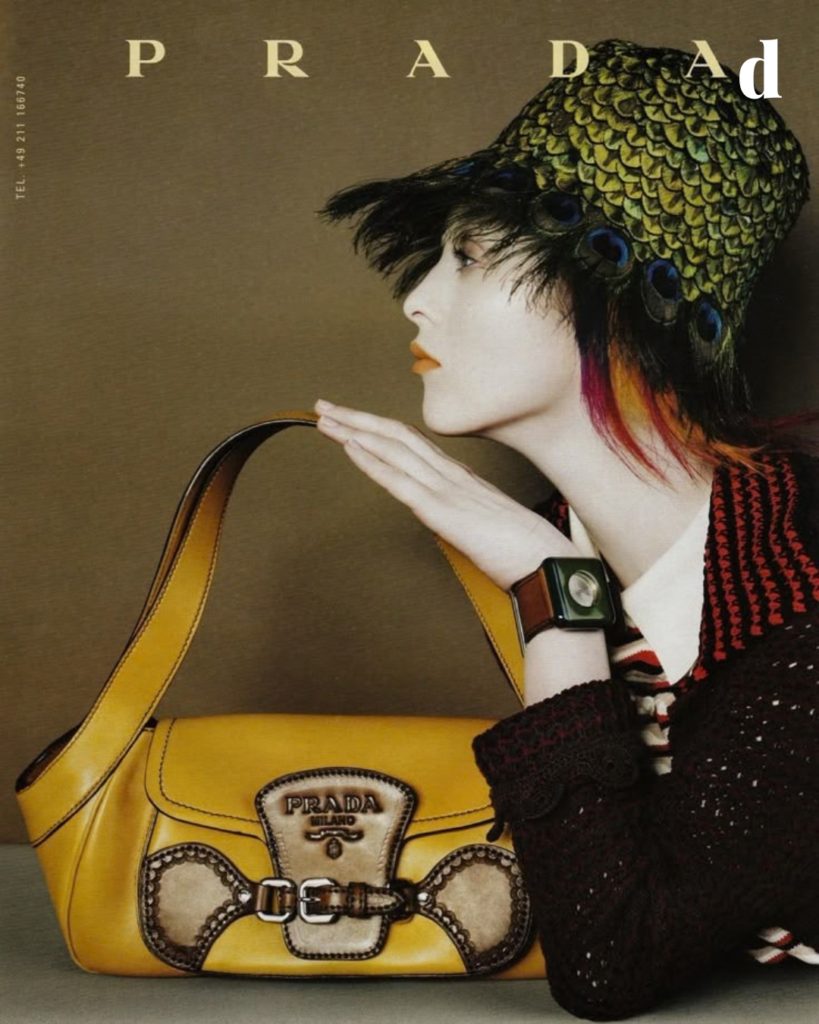
Prada’s history is ultimately not just the story of an Italian fashion house.
It is the story of how a family business became a cultural institution without forsaking its ability to question itself.
Founded in Milan in 1913, Prada entered the twenty first century with a reputation that had already been radically reshaped by Miuccia Prada and Patrizio Bertelli.
The brand transformed nylon into luxury.
It challenged standard ideas of beauty.
It brought art and architecture deeper into fashion.
It developed Miu Miu into a global brand.
It expanded into sports, eyewear, fragrance, food and other areas.
It established Fondazione Prada.
It experimented with technology and eco-friendliness.
It reached into space.
And through the partnership of Miuccia Prada and Raf Simons, it continues to reconsider what present day fashion can be.
The Spring 2027 collection provides a fitting example.
After more than a century, Prada can still take one of fashion’s most familiar garments and make the industry look at it differently.
That may be the house’s greatest legacy.
Not a particular bag.
Not a particular print.
Not even a particular decade.
But a method of thinking.
Question the obvious. Reconsider the ordinary. Challenge the expected.
From a leather goods shop beneath the glass roof of Milan’s Galleria Vittorio Emanuele II to a global luxury group shaping fashion, art, architecture and technology, Prada’s history has always been about changing the perspective.
And in 2026, the story is still being written.
Leave a Reply